D2D sales work because it removes the distance between the sales representative and the customer. A good rep can explain product benefits clearly, answer questions on the spot, and move prospects' shoes forward in one visit.
The real challenge begins when growth stops feeling exciting and starts feeling messy.
As D2D sales teams expand, cracks appear. More reps mean more doors, more territories, more follow-ups, and more data. Without structure, teams struggle to handle difficult-to-deal-with objections and misaligned sales goals. And what once felt manageable turns into daily confusion.
The Scalable D2D Sales Playbook: Systems, Automation, and Performance Visibility
Door-to-door sales, commonly called d2d sales, continue to deliver strong results for businesses that depend on local customer acquisition. Industries like solar, roofing, pest control, and home improvement services still rely on face-to-face conversations and personal connections to build trust and close deals faster.
Scaling D2D sales does not mean pushing reps harder. It means building a foundation that supports growth.
Additionally, top door-to-door sales teams rely on repeatable security systems, not memory or manual tracking. They remove friction from daily work and replace guesswork with clear data.
This door-to-door selling playbook shows how structure, automation, and real-time visibility create scalable D2D sales operations, with door-to-door sales tips for successful reps and guidance on identifying the target audience.
Key Takeaways
- Door-to-door sales teams don’t fail because of effort; they stall when growth outpaces structure.
- Manual tools like spreadsheets and notes create blind spots that lead to missed follow-ups, uneven territory coverage, and inconsistent performance.
- Automation removes daily friction by standardizing execution, ensuring no lead, follow-up, or activity is lost.
- Mobile-first tools are essential for real-world D2D execution, enabling reps to log activity instantly, even offline.
- Clear workflows, real-time visibility, and data-driven coaching allow teams to scale without losing speed, clarity, or control.
See what happens when follow-ups never slip, territories stay clean, and managers coach with real data instead of guesswork.
Take a closer look at how structured D2D teams scale without chaos- book a Knockbase walkthrough.
Determine The Real Reason D2D Sales Teams Fail to Scale
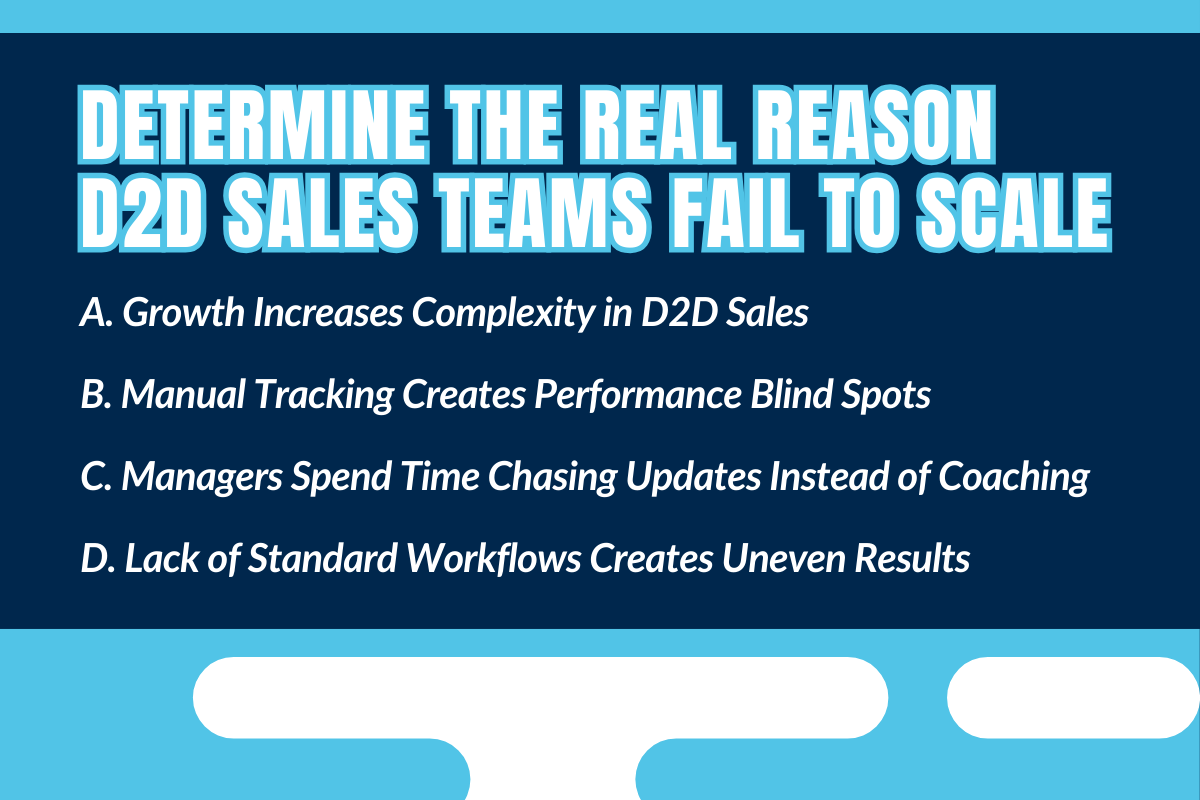
A. Growth Increases Complexity in D2D Sales
Scaling door sales increases everything at once. You hire more sales reps, expand into new areas with a new sales approach and sales pitch. You manage more leads and follow-ups.
However, without systems, complexity grows faster than control can keep up. You need more control over sales jobs, sales techniques, sales performance, and in-person sales when dealing with a new customer.
B. Manual Tracking Creates Performance Blind Spots
Many door-to-door sales teams rely on spreadsheets or notes. These tools break quickly as teams grow.
And as a result, reps forget updates, data comes in late, and managers cannot see real performance. This also means that decisions are based on assumptions rather than facts.
C. Managers Spend Time Chasing Updates Instead of Coaching
When sales systems are weak, managers spend all day chasing numbers. They call sales reps for updates and wait for end-of-day sales process reports.
This leaves little time for coaching, training, or strategizing. Also, the performance of sales representatives is kept on hold.
D. Lack of Standard Workflows Creates Uneven Results
Without clear workflows, sales reps operate differently. Some log activity, others do not. Follow-ups happen inconsistently, and you lose potential customers.
Output becomes unpredictable even when the sales effort is high. You need to monitor closing techniques and sales scripts to reduce turnover and increase customer satisfaction.
What Is D2D Sales?
Door-to-door sales (D2D) refers to a direct selling method where representatives visit potential customers' homes or businesses in person to sell products or services, relying on face-to-face interaction.
The D2D sales process is primarily used in industries that rely on local customer reach and the ability to build personal relationships, such as solar energy, roofing, home services, and telecommunications.
This sales model is effective because it provides sales representatives with a face-to-face opportunity to present product benefits, provide immediate answers to customer questions, and increase the likelihood of converting potential customers into actual buyers.
Companies adopting mobile CRM and tracking apps for D2D sales report an average sales increase of up to 29% and a 34% rise in overall sales productivity. [Source]
What a Scalable D2D Sales System Actually Looks Like In 2026?
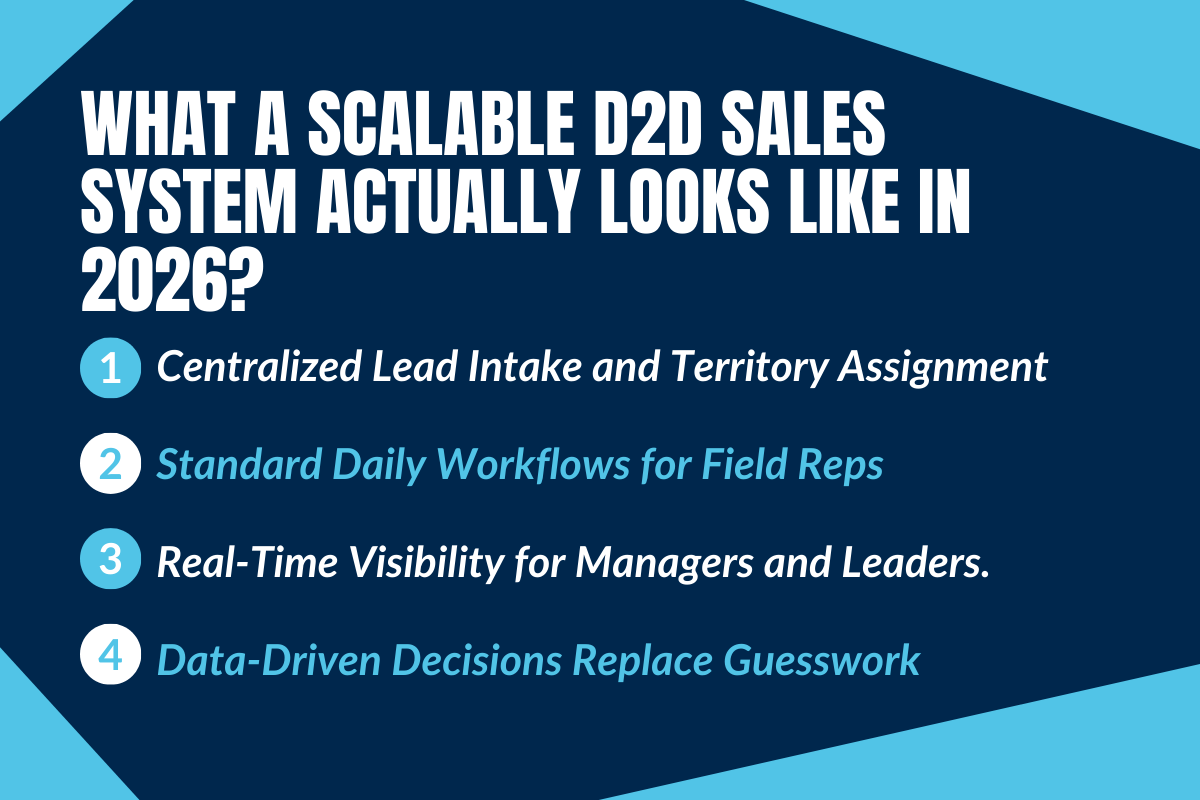
1. Centralized Lead Intake and Territory Assignment
A scalable D2D sales system starts with clarity and helps reps with maintaining proper body language, eye contact, and active listening through best sales tips.
All leads enter one platform, territories are clearly defined, and door salesmen know precisely where to work and who owns each area. This removes confusion and prevents overlap.
2. Standard Daily Workflows for Field Reps
High-performing teams don’t rely on memory or “doing it their own way.” They follow the same simple loop every day:
Knock the door → log the outcome → schedule a follow-up if needed → move on.
This consistency removes friction. Reps don’t forget details, leads don’t fall through the cracks, and follow-ups actually happen. Over time, these small habits compound into higher conversion rates and predictable output.
3. Real-Time Visibility for Managers and Leaders
Managers need visibility while work is happening, not after the day ends. Real-time activity tracking shows doors knocked, conversations held, and follow-ups scheduled.
Leadership sees trends instead of chasing reports. Instead of asking, “What happened today?” leaders can ask, “What’s slowing us down, and how do we fix it right now?”
4. Data-Driven Decisions Replace Guesswork
When data is clean and consistent, decisions stop being emotional.
Coaching becomes specific instead of generic. Territory changes are based on performance patterns, not gut feeling, and sales goals align with reality, not optimism.
This is what makes growth sustainable. The system adapts as the team scales, without creating confusion, burnout, or chaos.
Still confused before making a purchase? Watch the ROI here: The ROI of a Door-Knocking App for Growing Teams
How Automation Removes Bottlenecks in D2D Sales?
I. Automated Lead Capture and Assignment
In a growing D2D operation, speed matters. Therefore, automation ensures new leads reach the right sales rep and sales professional instantly.
There’s no waiting for spreadsheets to be updated or messages to be forwarded. The moment a lead enters the system, ownership is clear. As a result, faster response times lead to higher contact rates, smoother conversations, and a better experience for the homeowner, which directly improves conversion rates.
II. Workflow Automation for Door-to-Door Sales Reps
Automation removes repetitive tasks from the rep’s day and enhances digital marketing.
This consistency matters. When every rep follows the same automated flow, execution improves across the team. Follow-ups happen on time, opportunities move forward faster, and deal velocity increases without adding pressure or extra hours.
III. Automated Reporting for Sales Managers
Without automation, managers spend too much time chasing updates instead of coaching performance.
Automated reporting gives leaders real-time visibility into doors knocked, conversations held, objections faced, and follow-ups scheduled without asking reps to submit reports manually. Data is captured as work happens, not after the fact.
Why Mobile Tools Are Non-Negotiable for Scaled D2D Sales?
| Mobile Capability | Why It Matters for D2D Sales Teams | Business Impact |
|---|---|---|
| Mobile-first field access | D2D sales happen outside the office. Reps need tools that work on the go, not at a desk. | Higher rep adoption and consistent daily usage |
| One-tap activity logging | Reps log door outcomes immediately after each knock using their phone. | Accurate data and better performance tracking |
| Offline access | Reps continue working in low-signal or no-network areas. | Zero downtime and uninterrupted selling |
| Reduced admin work | Mobile tools remove manual entry and late updates. | More selling time per rep each day |
| Territory mapping | Mobile maps show clear boundaries and assigned areas. | No confusion or territory overlap |
| Route optimization | Reps follow optimized routes between doors. | More doors are knocked on per day |
| Reduced rep overlap | Explicit routing prevents multiple reps from hitting the same area. | Better door coverage and cleaner reporting |
| Real-time field updates | Managers see activity as it happens. | Faster coaching and better decision-making |
Watch how popular D2D sales team uses mobile apps here: How High-Performing D2D Salespeople Use Mobile Apps to Track Metrics and Boost Efficiency
Performance Dashboards That Drive Scalable Growth in 2026
A. Rep-Level D2D Sales Metrics That Matter
- Strong dashboards focus on meaningful metrics and product knowledge.
- Doors knocked per day show sales effort. The conversation-to-close ratio reflects skill and objection-handling. Follow-up conversion rate shows discipline.
- Many Sales Reps understand where they stand and how to improve.
B. Manager and Leadership Dashboards for Scaling Teams
- Managers track team health and inside sales at a glance, which makes territory performance clear.
- Underperformance shows early, allowing faster coaching and correction. Leaders gain confidence in real-time feedback.
- Easy to gather information about customer needs and evaluate top performers' selling patterns to reduce the constant rejection and build relationships.
How Structured D2D Sales Systems Improve Rep Performance?
Step 1: Clear Expectations Increase Confidence
When reps know which prospects buy and what success looks like, they perform better. Structure removes doubt through time management.
Step 2: Transparent Metrics Drive Healthy Competition
Visibility changes behavior. When activity and results are tracked openly, accountability becomes part of the culture.
Top performers stand out, underperformers know where they need to improve, and progress becomes measurable rather than subjective. This creates healthy competition driven by data, not pressure, and helps teams align around shared goals and expectations.
Step 3: Targeted Coaching Improves Results Faster
Structured systems replace generic feedback with specific, actionable coaching. Managers can see where reps struggle with openers, objections, follow-ups, or close rates and coach accordingly.
Instead of guessing or relying on anecdotes, feedback is grounded in real performance data. This makes coaching more practical, more relevant, and far more effective at improving results.
Step 4: Faster Ramp-Up for New D2D Sales Reps
New hires perform better when they aren’t left to “figure it out.” Clear workflows, defined steps, and built-in systems guide behavior from day one.
Reps know what to say, what to log, and what comes next after each interaction. As a result, first conversations with new or long-term customers feel more confident and professional, shortening the ramp-up period and helping new reps sell with ease sooner.
When to Move from Manual D2D Sales to Automated Systems?
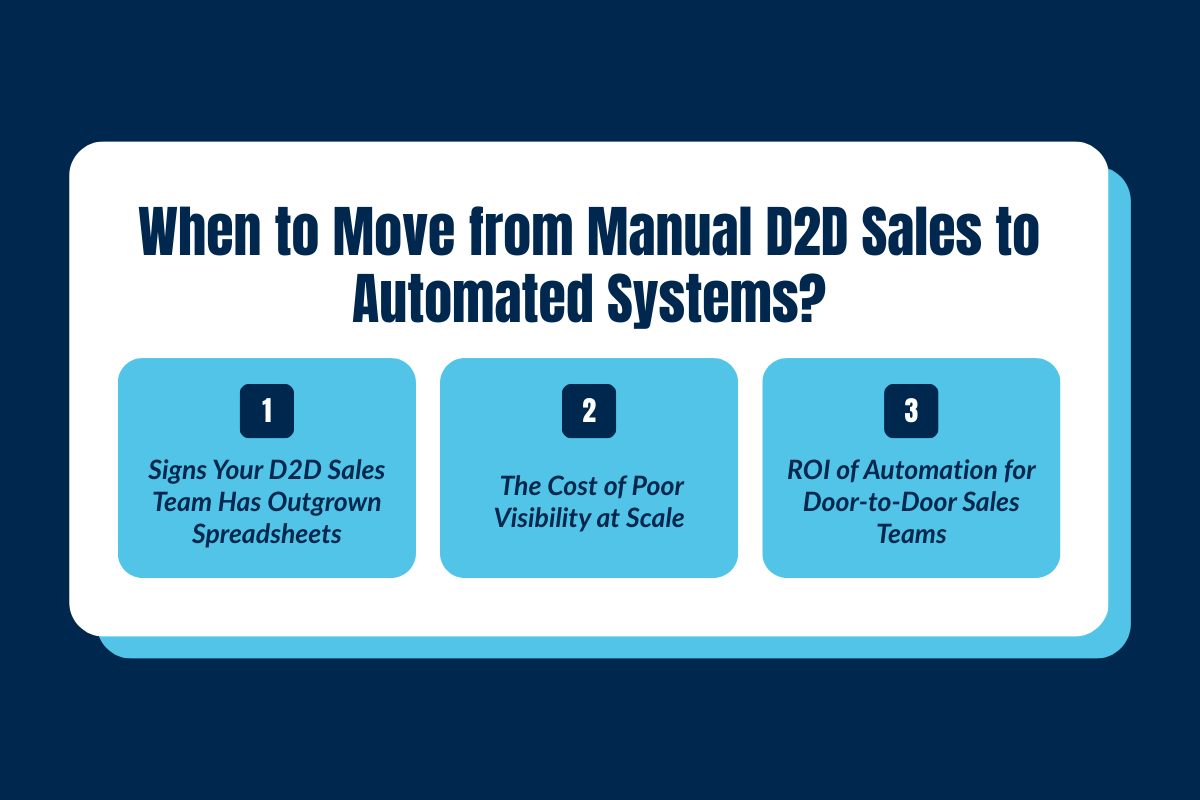
1. Signs Your D2D Sales Team Has Outgrown Spreadsheets
Spreadsheets work when teams are small, and activity is easy to track mentally. They stop working when growth introduces complexity.
If missed follow-ups, overlapping territories, inconsistent data, poor day-to-day visibility, and manager burnout start showing up regularly, it’s time to go for automated systems.
2. The Cost of Poor Visibility at Scale
When managers can’t see activity in real time, small problems become expensive ones. Leads slip through the cracks, and reps lose momentum.
Also, high-potential neighborhoods go underworked while others get over-canvassed. Poor visibility also creates frustration on the ground.
3. Revenue Is Inconsistent Despite Strong Activity
If teams are knocking on doors but results fluctuate wildly, the issue is rarely effort. It’s usually a lack of structure and follow-through.
Automation aligns activity with outcomes. It ensures the right actions happen consistently, which brings stability to revenue and forecasting.
4. Territories Start Overlapping or Going Cold
Manual territory management works only when teams are small. As reps increase, boundaries blur. Two reps knock the same street while another high-potential area goes untouched.
Automated territory assignment brings clarity. Every rep knows exactly where to work, managers see coverage in real time, and expansion becomes planned instead of reactive.
Building a Scalable D2D Sales Operation Without Losing Agility
Growth should not come at the cost of agility. Effective D2D sales systems stay easy to use and fast for reps in the field. When technology works quietly in the background, teams sell more without extra effort.
Step 1: Define Simple Daily Workflows for Reps
Start with the basics. Every rep should follow the same daily flow. A straightforward D2D sales workflow looks like this:
- Open the assigned territory
- Knock doors
- Log the door outcome immediately
- Schedule follow-up if needed
- Move to the next door
Keep it short. If a step does not help reps sell, remove it.
Step 2: Centralize Leads and Territory Ownership
Scaling fails when ownership is unclear. All D2D sales leads should be entered into a single system. Every territory should have a single owner at any time. Reps should know precisely where they are allowed to work.
Step 3: Use Mobile-First Tools Built for Field Work
Door-to-door sales happen outside, not behind a desk. Tools must be designed for mobile use and unreliable connectivity.
Choose tools that allow:
- One-tap activity updates
- Offline access
- Fast loading in the field
Avoid platforms built for office-based sales teams. If a tool slows reps down at the door, it will not scale.
Step 4: Automate Repetitive Tasks Early
Automation should handle anything that repeats daily. Reps should focus on conversations, not administration.
Automate wherever possible:
- Lead assignment
- Follow-up reminders
- Activity logging
- End-of-day reporting
When reps spend time on manual admin work, performance drops. Automation protects selling time
Step 5: Track Only the Metrics That Drive Performance
More data does not mean better decisions. Track only what informs action.
Core D2D sales metrics include:
- Doors knocked per day
- Conversations held
- Follow-ups scheduled
- Conversion rates
Avoid vanity metrics that look impressive but do not improve execution or coaching.
Step 6: Build Role-Based Performance Dashboards
Different roles need different levels of visibility.
Reps should see:
- Daily activity targets
- Personal performance trends
Managers should see:
- Team-wide activity
- Territory coverage and performance
- Gaps and underperformance
Leadership should see:
- Growth trends
- Forecast indicators
- System-level health
Role-based dashboards keep everyone focused on what matters at their level.
Step 7: Enable Coaching Through Data, Not Memory
Coaching should be objective, not subjective. Data removes bias and guesswork.
Managers should review:
- Missed follow-ups
- Low conversion points
- Territory gaps
When coaching is based on real activity data, feedback becomes specific, fair, and actionable. Reps improve faster because expectations are clear.
Step 8: Keep Systems Flexible as Teams Grow
Scalability requires adaptability. What works for 5 reps will not look the same at 50.
Your system should allow:
- Easy territory adjustments
- Workflow refinements
- Process updates without disruption
Avoid locking teams into rigid structures that slow response to market changes.
Step 9: Test, Improve, and Simplify Continuously
Every quarter, review how the system is actually being used.
Ask:
- Which steps do reps use daily?
- Which screens slow them down?
- Where does friction still exist?
Remove unnecessary steps, simplify workflows, and shorten execution paths. The best scalable systems get simpler over time, not more complex.
Conclusion: Structure Is the Growth Engine for D2D Sales
Door-to-door sales have always been about human connection. But scaling that connection requires structure behind the scenes.
As teams grow, effort alone stops being enough. Without automation, mobile-first execution, and real-time visibility, even high-performing reps get slowed down by confusion, missed follow-ups, and unclear priorities. That’s when growth starts to feel chaotic instead of controlled.
The most successful D2D teams don’t ask reps to work harder—they remove friction from their day. They standardize workflows, automate repetitive tasks, and give managers live insight into what’s actually happening in the field.
About Knockbase
Knockbase is built for growing D2D sales teams that need structure without complexity.
It centralizes leads, territories, and rep activity in one platform. Its mobile-first workflows support fast door-to-door execution. Automation handles follow-ups and reporting.
Additionally, real-time dashboards give managers and leaders complete visibility into team performance, helping d2d sales teams scale with confidence.
Teams that invest in structure grow faster and operate with clarity. So, book a demo today.
FAQs
Q.1 What are D2D sales?
D2D Sales, also known as Door-to-Door Sales, is a type of Sales in which representatives go directly to customers’ homes or places of business to market, present, and demonstrate products or services.
Q.2 Is D2D sales a promising career?
D2D Sales can be a viable career for individuals who enjoy face-to-face Interaction with their Customers and are looking for performance-based income. D2D Sales provides a pathway to rapidly develop strong Skills in Communication, Negotiation, and Resilience.
Q.3 How hard is D2D sales?
D2D Sales can be difficult due to the many challenges Sales Representatives face daily, including the need for Persistence, Discipline, and the ability to deal with Rejection. Climate Conditions, Long Hours, and Physical Effort can also make D2D Sales demanding at times.
Q.4 What is the difference between B2B and D2D?
When selling to businesses (B2B), sales cycles are generally longer and involve multiple decision-makers, whereas D2D sales targeting individual customers directly in their homes typically have shorter sales cycles and lead to quicker purchasing decisions.

Canvassing Software ROI: How Sales Managers Should Calculate Cost-Per-Knock vs Cost-Per-Lead in 2026