Traditional, pushy door-to-door scripts fail in Europe as buyers expect clarity, cultural respect, and strict privacy compliance. With 27 countries, multiple languages, and GDPR, reps can’t rely on generic lines.
Yet door-to-door still beats digital ads because face-to-face trust is stronger. Industries like broadband, solar, home services, pest control, and charities still depend on reps who can communicate clearly and adapt to local expectations.
The real challenge isn’t selling, it’s speaking in a way that feels natural, culturally aware, and respectful. Modern scripts exist not to make reps robotic, but to provide structure, confidence, and consistency at every door.
How Can Door-to-Door Salespeople in Europe Build Winning Scripts and Handle Objections With Confidence?
Door-to-door salespeople succeed by using simple, respectful scripts adapted to local culture and GDPR rules. A strong script isn’t memorised, it’s a flexible guide that helps you open naturally, qualify quickly, and respond calmly to objections.
Every European region expects something different: some want politeness, others prefer directness, and most want transparency before sharing any personal details.
These modern, conversation-first scripts work for door-to-door salespeople across telecom, broadband, solar, energy, pest control, home improvement, and non-profit teams. They help build instant rapport, boost confidence, and reduce friction around trust, price, urgency, or data privacy.
In this guide ahead, for beginners, scripts can act as a support system; for experienced reps, they can become a repeatable playbook. With localisation and compliance built in, European sales teams can handle objections more smoothly while keeping interactions human and respectful.
Key Takeaways
- Modern door-to-door sales in Europe require natural, localised scripts that adapt to each country’s language, tone, and cultural expectations.
- GDPR compliance is non-negotiable, so reps must use privacy-safe openings and avoid collecting data without a clear purpose.
- Winning scripts focus on rapport first, not product dumping; clarity, and trust beat pressure every time.
- Objection handling becomes easier when reps use structured frameworks (clarify → validate → respond → close) that sound human, not rehearsed.
- Teams that standardise their scripting and localisation see higher confidence, smoother conversations, and better conversion rates across regions.
Want reps to handle objections with more confidence?
With Knockbase, sales teams get the structure they need without losing their voice — so objections feel manageable, not intimidating. → Try Knockbase Sales Rep Management Software and give your team the flexibility to adapt to every conversation.
Why Door-to-Door Sales in Europe Require Smarter, Localized Scripts?
Europe isn’t one market; it’s dozens of micro-cultures living side by side. A line that works well in Belgium may fall flat just a few streets away in the Dutch quarter. Moreover, young reps lose confidence when rigid, one-size-fits-all scripts sound forced rather than natural.
Using the same pitch everywhere leads to instant distrust. To get real engagement, scripts must adapt to local habits, language tone, and neighbourhood expectations. Localized, flexible messaging is the only way to avoid awkward interactions and build a genuine connection at the door.
What Makes Europeans Say Yes, or Close the Door: Understanding Buyer Psychology?
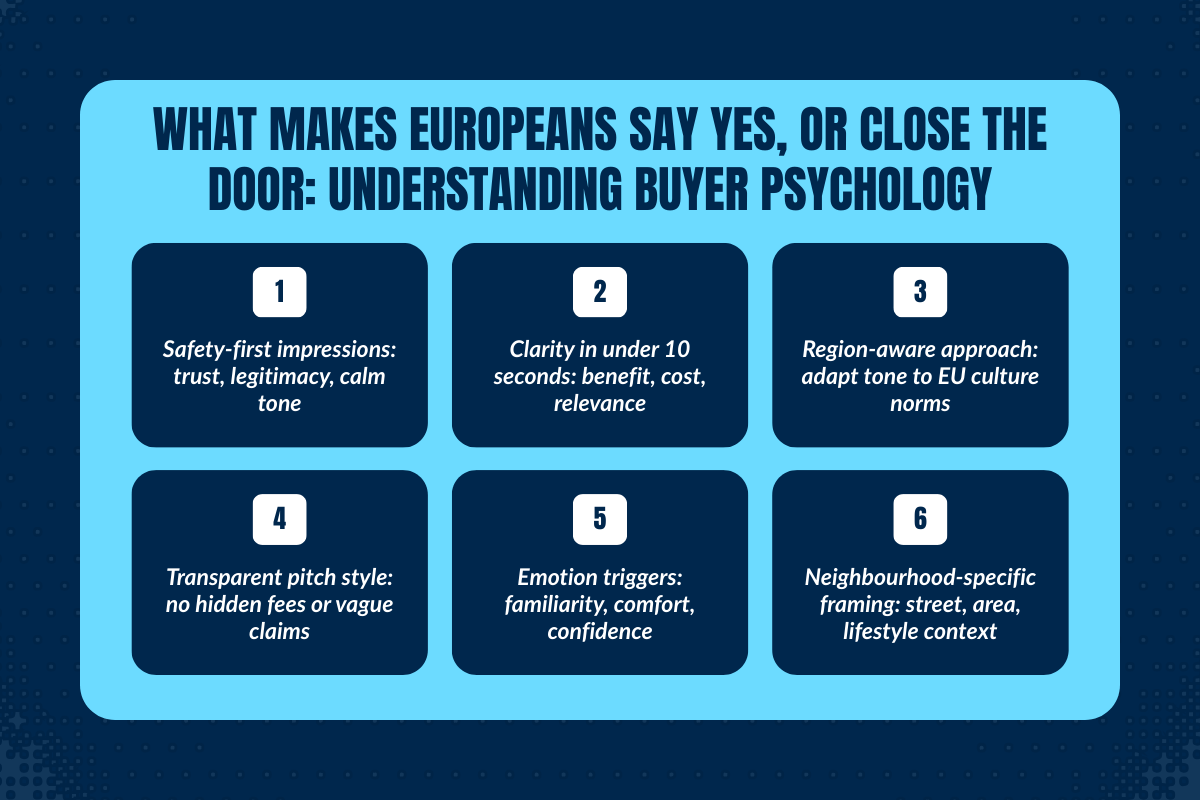
For any door-to-door salesperson in the EU, understanding why someone opens the door, listens, and eventually says yes matters more than memorising scripts.
In European markets, psychology, empathy, and cultural awareness decide whether you win a deal or lose the customer in seconds in your sales job. The skill isn’t about being loud or clever, it's about being human and relevant.
1. Emotional Drivers: Safety, Clarity, Familiarity, Transparency
European buyers make decisions instantly, often before your opener ends. Their reaction is shaped by four emotional triggers:
- Safety: Is this person trustworthy? Most Europeans hesitate to open the door because of scams, spam, and competition from multiple brands. Sales reps must look professional, speak calmly, and show legitimacy early. A company badge, uniform, or even arriving in a company car increases trust before the conversation begins.
- Clarity: Am I understanding the offer quickly? Buyers don’t want complex pitches. They want the benefit upfront: “Will this save me money?” “Does this improve my house?” “What’s the cost?” The quicker you explain this, the better the conversion rates.
- Familiarity: Does this feel relatable and region-specific? A script that works in Spain typically won’t work in Germany. Europeans respond to tone, region, and cultural style. Building long-term relationships starts with sounding like you understand the neighbourhood, the street, the household rhythm, and local expectations.
- Transparency: Are they hiding fees or obligations? The fastest way to get a closed door is to sound evasive. Transparency gives customers confidence to listen longer, ask questions, and consider the benefits for their home or life, and other things. This is especially important in home improvement and solar panels, where buyers are investing to pay their serious money.
2. How the First 10 Seconds Decide Everything
- In door-to-door selling, people judge you within 7–10 seconds. Your tone, posture, and warmth matter more than the script itself.
- A calm, respectful opener instantly reduces risk and earns attention, especially on busy European streets where time is limited.
- Top performers keep their introductions short and human.
- No pressure, no long speeches, just a friendly tone and good timing to make the potential customer comfortable enough to listen.
3. Cultural Expectations That Shape Trust Across EU Regions
Europe isn’t one market; it's a collection of cultures, behaviours, and unwritten rules. Every door-to-door team must adapt scripts across regions rather than forcing a one-size-fits-all process. This section is essential for reps aiming for full training, full-time roles, or career progression into leadership.
A. Southern Europe (ES, IT, PT): warmth, storytelling, relationship-building.
- People respond better when you build a small moment of connection before talking business.
B.. Northern Europe (DE, NL, DK, SE): directness, efficiency, clarity.
- People prefer clarity and efficiency. Keep intros short, factual, and benefit-led.
C. Western Europe (FR, BE, LU): polite, formal, precise.
- A respectful tone and structured message increase trust.
D. Eastern Europe (PL, CZ, HU, SK): practical benefits, proof, rational outcomes.
- Buyers expect practical reasons and credible evidence.
How to Localize Scripts Across Europe Without Rewriting Everything
You don’t need entirely different scripts for 27 countries; you just need regional adjustments in tone, pace, and proof. Here’s how reps adapt on the street:
1. Northern Europe (DE, NL, DK, SE): “Get to the point fast.”
Here, consumers prefer straight-to-the-point messaging. They value professionalism, precision, and respect for time. A rep should mention cost, benefits, and the core deal early. Avoid over-talking, deliver value quickly, then allow them to ask.
- Example opener: “Hi, quick info about reducing your monthly energy costs. Takes 20 seconds.”
- What matters most: clear benefits, proof, and transparent pricing.
2. Southern Europe (ES, IT, PT): “Warmth first, pitch second.”
In these regions, people respond to emotional connection, genuine warmth, and personal conversation. A friendly story or a relatable example can open doors faster than a technical pitch. These buyers appreciate reps who take a moment to greet, ask simple questions, and show passion for the services they represent.
- Example opener: “Hola! We’ve been helping a few neighbours with energy savings today. Mind if I share something quickly?”
- What matters most: friendliness, conversation, relaxed pace.
3. Western Europe (FR, BE, LU): “Polite, formal, precise.”
A respectful and well-structured introduction is key. Buyers expect a balance between friendliness and formality. Even in sales, you must sound like you represent a serious company, not a casual gig. The right phrasing, tone, and local vocabulary matter greatly.
- Example opener: “Bonjour, I’d like to share a quick update on energy-saving options available in your area.”
- What matters most: courtesy, clear purpose, no surprises.
4. Eastern Europe (PL, CZ, HU, SK): “Show the value, show the proof.”
These regions respond best to tangible benefits, savings, reliability, and logical reasoning. Show data, proof, or small examples of results delivered to neighbours.
They value honest conversation over exaggerated claims.
- Example opener: “Hello, we’re helping homes reduce monthly bills. Here’s how your neighbours benefited.”
- What matters most: savings, reliability, real examples, or case studies.
Learn more: The Ultimate Guide to Becoming D2D Experts: Skills, Training & Tools (2026 Edition)
How To Build Scripts That Actually Work: A Modern Framework for EU Door-to-Door Salespeople
Here’s a repeatable formula to make scripts feel natural but structured:
Step 1: Crafting an Authentic Opening Line That Doesn’t Feel Scripted
Keep it short, respectful, and culturally appropriate according to the region. For example:
- “Bonjour, a quick update about energy-saving options in your street.” (FR)
- “Hoi, I’m doing a small solar panel check with neighbors today.” (NL)
Step 2: The “Value in 15 Seconds” Rule
European buyers won’t stick around for a long monologue. Deliver your value proposition quickly:
- Highlight a benefit they can see or save immediately.
- Avoid pressure; focus on information and choice.
Step 3: Using Social Proof Without Sounding Like a Pitch
Mention:
- Neighbours who have already benefited.
- Local or regional case studies.
- Relatable, human examples instead of vague statistics.
Step 4: A Gentle CTA That Fits European Cultural Norms
Close softly:
- “Would it be okay if I left some info for you?”
- “Could I show you a quick example of how this works?”
- No hard sells, comfort first.
Why Traditional Objection Handling Fails in Europe?
Generic rebuttals often feel aggressive or insensitive. Objections today stem from:
- Trust concerns: “Who are you and why are you at my door?”
- Privacy worries: “Are you collecting my data?”
- Time constraints: “I’m working, cooking, or managing the kids.”
- Cultural discomfort: “Your tone or approach doesn’t match how we communicate here.”
Sales reps freeze because they were trained to argue back, not to listen. This creates tension, reduces conversion rates, and makes the interaction feel transactional instead of helpful.
Modern EU selling requires not overpowering objections, but understanding the intent behind them, acknowledging it, and guiding the conversation with empathy.
Also read: 8 Common Pitfalls in Door-to-Door Campaigns -and How to Avoid Them
The New EU Objection Handling Model: Empathy, Clarity, and Cultural Awareness
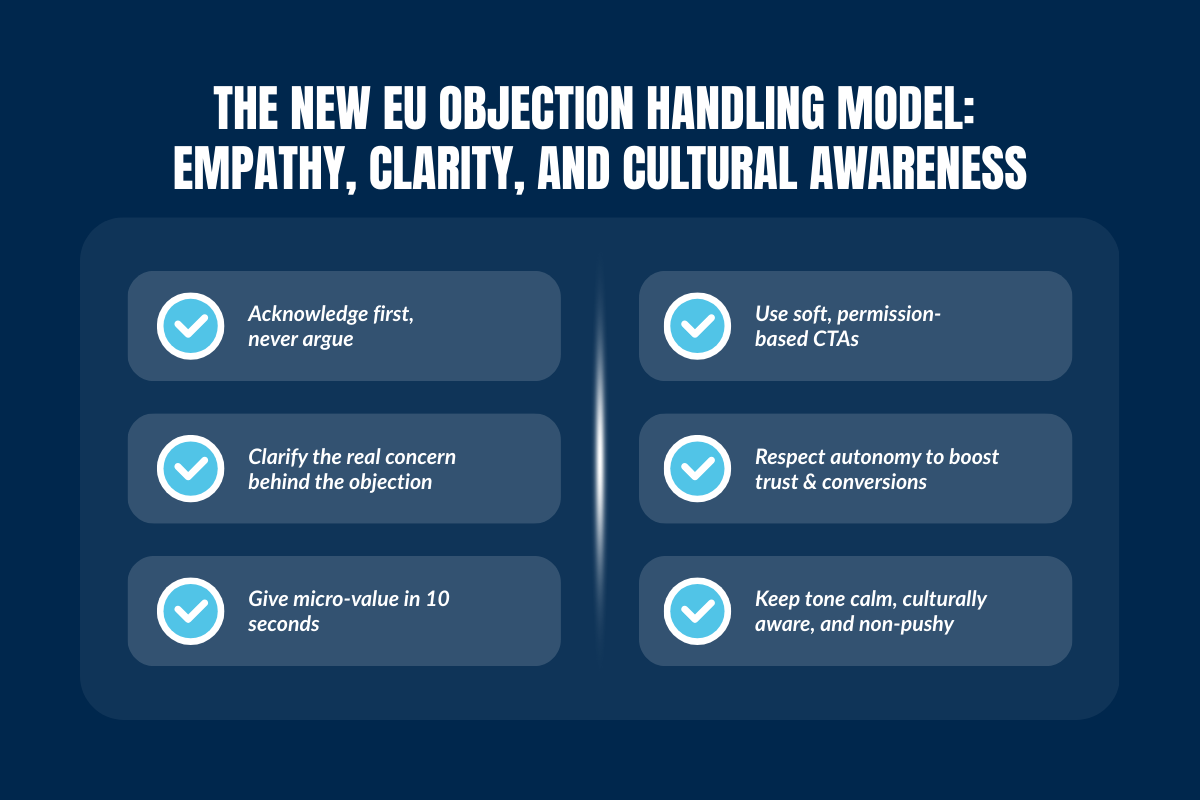
Top-performing sales reps across the EU use an approach rooted in empathy, cultural awareness, and calm clarity. This model helps you protect leads, keep the door open, and convert hesitant potential customers into long-term relationships.
Step 1: Acknowledge Without Arguing
The worst mistake in door-to-door selling is pushing back. The moment a customer feels challenged, the door closes, physically and psychologically.
Always start with reassurance:
- “I understand, many people feel the same at first.”
- “No problem at all, let me explain quickly.”
Acknowledging reduces tension and proves you’re a professional, not an aggressive salesperson chasing sales targets or salary bonuses.
Step 2: Clarify the Real Concern
Most objections hide a deeper worry, cost, timing, trust, or data privacy. Clarification helps you tailor your answer and show you’re focused on the customer’s needs, not just closed deals.
Use gentle, low-pressure questions:
- “Is it mainly the cost or the timing that you’re unsure about?”
- “Do you prefer more information before deciding?”
This works for any industry, home security, home services, utilities, or retail doorstep campaigns.
Step 3: Offer Micro-Value
A “micro-value” is a 10-second helping hand, not a sales pitch. It keeps the conversation alive without overwhelming the person standing at their door.
Examples:
- “Many neighbours here reduced their energy bills by 20% after switching.”
- “This only takes 30 seconds and helps you understand if it’s even relevant for your house.”
This small value makes potential customers more open to follow-ups, even if they don’t say yes immediately.
Step 4: Check Comfort, Not Commitment
European consumers dislike pushiness. Instead of forcing the prospect toward a decision, invite them into the process.
Use soft, permission-based CTAs:
- “Would it be okay if I left you a quick info sheet?”
- “Can I show you a 10-second example?”
- “If it helps, I can note down a time that suits you, only if you want.”
This approach increases conversion rates because it respects autonomy, one of the biggest trust factors in EU door sales.
Real EU Objection Scenarios and How to Answer Them Naturally
- “It’s too expensive.” → Show practical savings or flexible options.
- “I don’t know you.” → Share local references, politely prove legitimacy.
- “I’m not comfortable sharing info.” → GDPR-safe language; focus on optional sharing.
- “I’m busy.” → Offer a micro-pitch and leave info for later.
For more region-specific:
1. Germany: “We don’t discuss contracts at the door.”
Resident: “Wir besprechen keine Verträge an der Tür.”
Meaning: We don’t discuss contracts at the door.
Rep Response:
“Natürlich, kein Vertrag an der Tür. Ich lasse Ihnen nur eine kurze Info da, völlig unverbindlich.”
Meaning: Of course, no contract at the door. I’ll just leave a short info sheet, totally non-binding.
2. France: “I don’t fully understand this.”
Resident: “Je ne comprends pas bien.”
Meaning: I don’t fully understand this.
Rep Response:
“Pas de souci, je vous explique les points importants en moins d’une minute.”
Meaning: No worries, I’ll explain the key points in under a minute.
3. Netherlands: “Just send me everything by email.”
Resident: “Stuur het maar per e-mail.”
Meaning: Send it by email.
Rep Response:
“Zeker, ik stuur u een korte samenvatting. Geen verplichting, bekijk het wanneer het uitkomt.”
Meaning: Sure, I’ll send you a short summary. No pressure, check it whenever you want.
4. Belgium (FR/NL): “I don’t trust door-to-door sales.”
French-speaking resident:
“Je ne fais pas confiance au porte-à-porte.”
Meaning: I don’t trust door-to-door sales.
Rep Response (FR):
“Je comprends. C’est pour ça qu’on suit la procédure officielle, badge, papier, tout transparent.”
Meaning: I understand. That’s why we follow the official procedure, badge, paperwork, and full transparency.
Dutch-speaking resident:
“Ik vertrouw deur-aan-deur verkoop niet.”
Meaning: I don’t trust door-to-door sales.
Rep Response (NL):
“Begrijpelijk. Daarom tonen we altijd ons ID en laten we alles zwart-op-wit achter.”
Meaning: Understandable. That’s why we always show ID and leave everything in writing.
5. Switzerland / Luxembourg: “We don’t speak English.”
Resident:
“Wir sprechen kein Englisch.” On ne parle pas anglais.” / “Non parliamo inglese.”
Meaning: We don’t speak English.
Rep Response:
“Kein Problem / Pas de problème / Nessun problema”, ich habe Infos in Ihrer Sprache. Was bevorzugen Sie?”
Meaning: No problem, I have info in your language. Which do you prefer?
6. EU-wide: “We already have another provider.”
Resident:
“Wij hebben al een andere leverancier.” / “On a déjà un fournisseur.” / “Wir haben schon einen Anbieter.”
Meaning: We already have a provider.
Rep Response:
“Geen probleem, ik vraag niet om vandaag te veranderen. Ik kijk gewoon of uw tarief nog steeds klopt.”
Meaning: No problem, I’m not asking you to switch today. I just checked if your current rate is still fair.
Why Testing and Iterating Scripts Matter More Than Ever
In modern door-to-door sales, success isn’t about using one “perfect script.” It’s about testing, adapting, and refining based on real conversations at the door.
With digital transformation shaping sales teams across Europe, scripts must evolve just as quickly as customer needs, local regulations, and market expectations.
1. Micro-Metrics That Predict Conversion
Top-performing teams don’t guess, they measure. These small but powerful indicators help predict whether a script will convert:
- First 7 seconds: Buyers decide whether to continue the conversation almost instantly. Tone, clarity, posture, and cultural fit make or break the interaction.
- Script length: Short, value-first scripts consistently outperform long monologues. The best ones deliver usefulness in under 20 seconds.
- Objection patterns: Tracking repeated objections across regions (timing, cost, trust, competition) helps teams refine messaging and train reps more effectively.
2. Tracking Region-Specific Patterns
Different EU markets react differently to the same script. That’s why salespeople must:
- Identify which openings work in which neighbourhoods.
- Learn why one region values proof (e.g., Germany) while another values warmth (e.g., Spain).
- Recognise how language tone affects trust and follow-ups.
- Adjust delivery based on what local consumers respond to, not what worked elsewhere.
This approach gives reps the best chance to close more deals while connecting authentically.
3. Why Teams Need a Central Script Library
A well-maintained script library helps salespeople, managers, and new employees stay aligned:
- Consistent messaging:
Ensures every rep communicates the brand, benefits, and processes the same way. - Faster onboarding:
New hires get full training faster by studying proven examples instead of guessing at the door. - Improved training outcomes:
Teams learn from top performers, understand what actually works in the field, and avoid repeating mistakes.
A central library becomes the team’s real-time playbook, a living resource that keeps getting smarter as the team collects more leads, closed deals, and insights from the street.
How Software Enables Better Scripts, Smarter Training, and Consistent Localisation
Good tools take the guesswork out of door-to-door sales. Instead of relying on memory or scattered notes, reps get structured, locally relevant guidance:
- Store region-specific scripts for quick access: Reps instantly pull the right opener or pitch based on country, language, or neighbourhood, no more generic lines.
- Track objection trends to refine messaging: When the same concern keeps coming up in a region, teams can update scripts in minutes and train reps accordingly.
- Ensure GDPR-safe communication: Built-in compliance prompts prevent misuse of personal data, helping reps stay confident and legally aligned.
How Knockbase Helps Door-to-Door Teams Build Confident, Localised, Compliant Scripts?
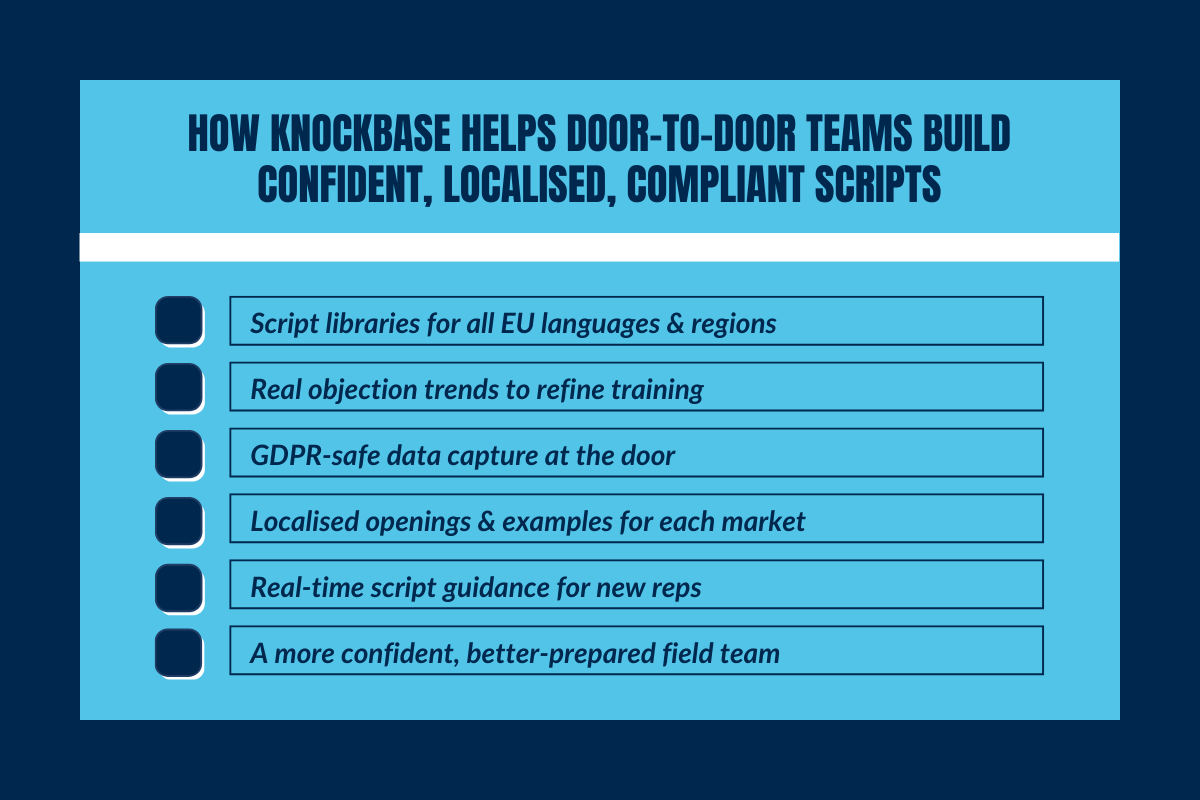
Knockbase works quietly in the background to make every rep more confident during face-to-face interactions across Europe. Instead of pushing a hard sell, it acts as a training, organisation, and localisation system that supports reps with different levels of previous experience.
- Script libraries for EU languages and regions: Reps get instant access to openings, examples, and variations tailored to specific streets, cultures, and markets, so they can focus on the business, not memorising lines.
- Objection trends and insights: Teams can see what real customers say at the door, helping managers refine training, prepare employees better, and increase the chances of turning conversations into signed accounts.
- GDPR-compliant data capture: No messy notes or risky paperwork. Reps collect details safely while protecting the customer, the company, and themselves.
- A more confident, prepared field team: Whether someone works flexible hours or full-time, Knockbase ensures everyone has the same quality tools, giving them a fair chance to earn, perform, and grow in a competitive world.
Checklist: What Every Door-to-Door Salesperson Should Carry in Europe
A well-prepared salesperson has a higher chance of turning a simple knock into a meaningful conversation. Here’s what reps should always carry to boost trust, follow-ups, and closed accounts:
- Script variations: Short versions, long versions, and regional adaptations for different types of customers.
- Cultural notes per region: Small details about tone, formality, and etiquette make face-to-face interactions smoother.
- GDPR-safe data capture: A secure way to log customer names, interest levels, objections, and follow-up needs.
- Regional price sheets: Transparent pricing helps customers feel safe and reduces objections related to cost.
- Neighborhood insights: Street-level details, recent installs, customer needs, and past visits, help reps personalise their pitch.
- Identity verification: A simple way to prove who you are and which company you represent, building instant trust.
- Objection comfort responses: Quick, natural lines that calm the customer rather than pressure them.
This checklist ensures that reps don’t just knock, they connect.
Conclusion:
Door-to-door selling still works across the EU because no digital marketing tool can replace the power of real, human, face-to-face interactions. What’s outdated isn’t the job; it’s the old scripts, the pressure tactics, and the lack of cultural understanding.
A modern European sales rep needs empathy, clarity, and the confidence to adapt from street to street. With structured tools like Knockbase, teams can organise scripts, stay GDPR-safe, support employees with different experience levels, and focus on what matters most: earning trust and building long-term relationships in a diverse world.
About Knockbase
Knockbase is an all-in-one platform specifically designed for modern door-to-door sales teams, helping you adapt scripts across regions, handle objections with confidence, and track performance, all while staying GDPR-compliant. Build culturally accurate scripts faster →Try Knockbase.
FAQs
1. What makes an effective D2D opener in European neighbourhoods?
Great openers are short, respectful, and tailored to the region. For example, Northern Europe prefers direct value-first lines, while Southern Europe responds better to warm, conversational starts. The opener should reduce tension, explain the purpose, and invite a small “yes.”
2. Do I need different scripts for every EU country?
Not entirely, focus on regional adaptations and cultural tweaks rather than rewriting everything.
3. Can Knockbase help with GDPR compliance?
Yes, it ensures all data collection and consent are safe and logged.
4. What objections are most common in European door-to-door sales?
The most frequent objections are privacy concerns, lack of time, distrust of unknown brands, and discomfort with direct sales. These vary by region. Northern Europe values transparency, Southern Europe values rapport, and Eastern Europe values reliability and savings.
5. How do I measure my script’s success?
Track micro-metrics like first 7 seconds, objection patterns, and closing rates per region.
6. How do GDPR rules affect door-to-door sales scripts?
You must clearly state who you represent, why you want the contact details of the resident, and how any information will be used. Scripts should avoid collecting unnecessary personal data. Using GDPR-aligned phrasing builds trust and prevents compliance risks during field visits.