Sales techniques have evolved, and old tactics no longer work. Buyers in the digital age already know your product features, benefits, pricing, and even your ratings, even before you start presenting.
Sales professionals today do more than sell. They need to build trust and credibility by leveraging technology to reach the right audience and establish a sustainable pipeline.
This guide explores how door-to-door sales are evolving and shares insights from top sales experts to turn every knock into a conversion because door-to-door sales still stand strong when you have the right approach.
How Has Door-to-Door Sales Evolved in 2026, and What Strategies Still Work?
The mechanics of door-to-door sales have not disappeared, but the margin for error has narrowed. In 2026, performance is no longer driven by enthusiasm alone. It is shaped by preparation, precision, and the ability to read situations quickly.
Field sales today operate in a faster decision environment. Homeowners expect relevance immediately, and they disengage just as quickly when the interaction feels unfocused. This shift has forced teams to move away from volume-based knocking and toward intentional territory selection, tighter qualification, and structured follow-up.
What separates high-performing reps now is not how many doors they approach, but how deliberately they approach them. Strategy begins before the first knock, continues through a controlled conversation, and extends into disciplined post-visit execution.
Key Takeaways
- Modern D2D sales succeed by building rapport through customer-centric conversations, with reps who master objection handling while leveraging technology to maximize productivity.
- Success comes from fostering real human relationships through authentic conversations that solve problems with personalized solutions, building credibility along the way.
- Tools like Knockbase help organize the sales process and empower field reps to build meaningful relationships with prospects, increasing closed deals through its suite of smart features.
Action that sets D2D sales on the Right Track
Take the right action to transform your sales team into a smart engine that drives your pipeline forward. Explore Knockbase Canvassing Software, your partner in digitizing workflows and selling smarter.
How has Door-to-Door Sales Evolved (The Reality of Door-to-Door Sales in 2026)?
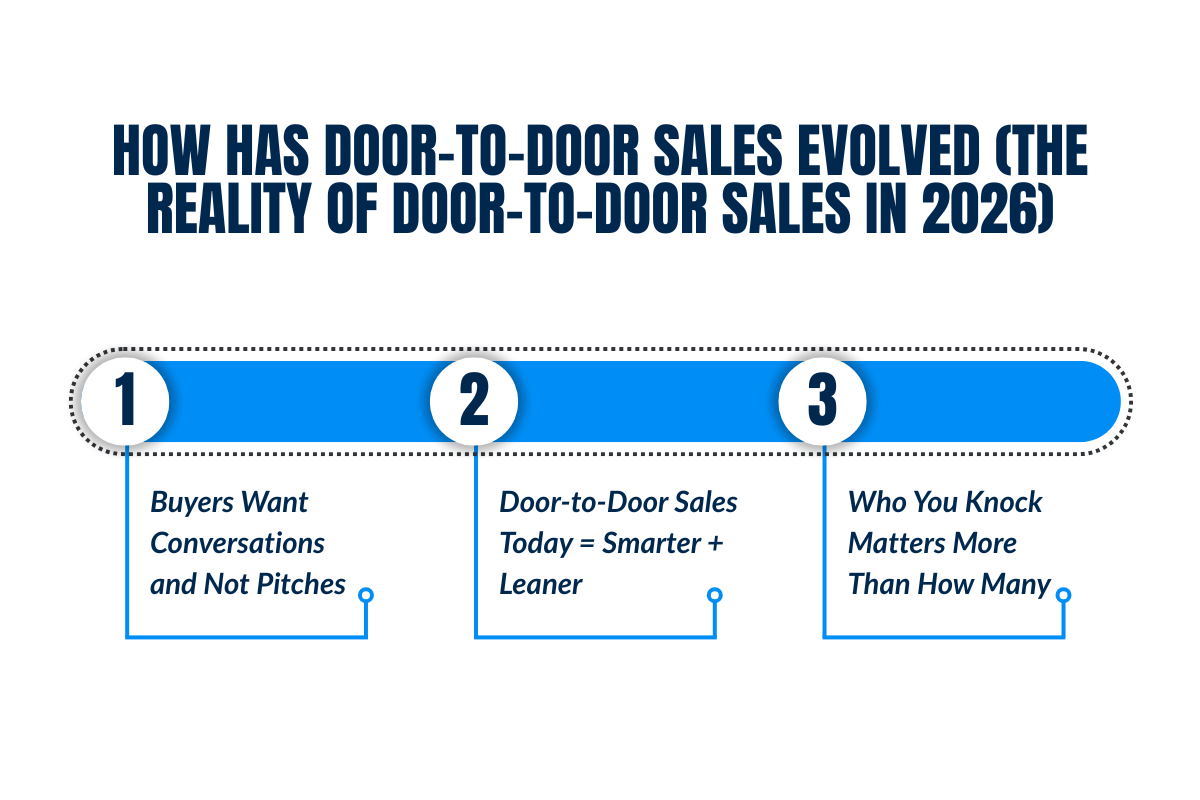
1. Buyers Want Conversations and Not Pitches
Sales reps have always followed the norm to dress appropriately, maintain eye contact, and begin with an impressive opening, but in reality, this no longer works in the digital age.
Dumping a list of features as a one-sided pushy conversation results in distrust, as customers are wary of misleading offers.
Buyers need conversations where sales reps handle objections with confidence, lead with value-first discussions that solve real problems, and demonstrate active listening, revealing practical solutions to customer pain points.
2. Door-to-Door Sales Today = Smarter + Leaner
Knocking on 100 doors with a clipboard and paper map is no longer a strategy; it’s guesswork. In 2026, modern door-to-door sales run on technology.
Reps are no longer relying on memory, printed lists, or gut feeling to decide where to go next. They use mobile CRM systems, digital territory mapping, and performance dashboards to guide daily execution.
Technology removes friction from the day. Instead of wasting time backtracking across streets or forgetting conversations, reps operate inside a structured system.
3. Who You Knock Matters More Than How Many
One of the biggest myths in door-to-door sales is that volume alone guarantees success. More doors do not automatically equal more deals.
What truly drives conversion is relevance. Knocking with intent, in the right neighborhood, at the right time, in front of the right homeowner, produces higher-quality conversations and stronger close rates.
Prospects buy when they feel understood and see real value. That requires communication skills, situational awareness, and the ability to quickly establish credibility.
The modern reality is clear: focused targeting plus strong conversation skills outperform blind hustle every time. In 2026, effectiveness beats exhaustion.
Then vs Now — How Changes in Buyer Behaviour Are Shaping D2D Conversion Rates
To understand why traditional tactics underperform today, consider the structural shift in buyer psychology:
| Aspect | Traditional D2D (Then) | Modern D2D – 2026 (Now) |
|---|---|---|
| Product Knowledge | Sales reps were the primary source of information. | Buyers research products, pricing, and competitors before you knock. |
| Buyer Mindset | Curious and open to being educated. | Skeptical, comparison-driven, and time-sensitive. |
| Type of Questions | Broad, general interest questions. | Specific, technical, and ROI-focused questions. |
| Decision Dynamics | Multiple visits are required to build awareness and trust. | Faster decisions when credibility is established immediately. |
| Trust Signals | Built mainly through rep personality and persuasion. | Driven by online reviews, brand reputation, and digital presence. |
| Attention Span | Longer tolerance for extended pitches. | Short attention window; relevance must be established quickly. |
| Follow-Up Channels | Phone calls and repeat in-person visits. | SMS, email, CRM-driven reminders, and digital proposal links. |
| Conversion Driver | Volume-based knocking and persistence. | Targeted conversations, data-backed routing, and tech-enabled follow-up. |
What Outdated Door-to-Door Sales Habits Are Killing Your Conversions in 2026?
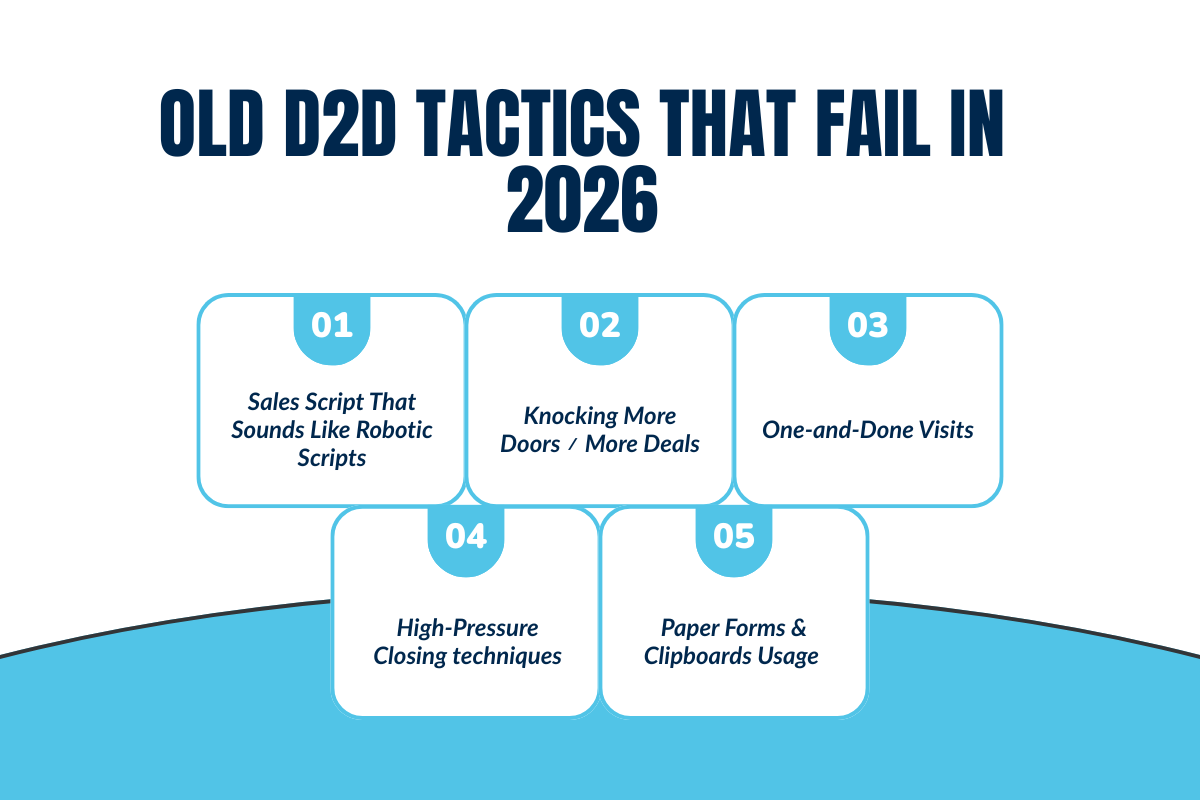
1. Talking Too Long Before Qualifying Interest
- Fail: Many reps still try to fully explain the product before confirming interest. In 2026, attention spans are short, and long explanations without qualification drain momentum fast. When reps over-explain early, homeowners mentally check out before the real conversation even begins.
- Fix: Qualify first. Use short discovery questions to confirm relevance before expanding into details. The goal isn’t to educate immediately; it’s to determine whether the door is worth deeper engagement.
2. Treating Every Door Like a Closing Opportunity
- Fail: Some reps still push for full commitment at every door, even when signals show the homeowner isn’t ready. This creates tension, lowers trust, and increases rejection rates. Not every interaction is a closing moment, and forcing it damages future potential.
- Fix: Adopt micro-commitments. Focus on booking the next logical step, an inspection, consultation, or proposal review, instead of demanding an immediate decision.
3. One-and-Done Visits
- Fail: 60% of customers say 'no' four times before finally accepting the deal!. To make new customers, a one-off visit is never enough; if you fail to nurture leads, the deals collapse!
- Fix: Modern door-to-door selling uses hybrid follow-ups to stay present without being intrusive. QR codes linking to personalized proposal pages, short WhatsApp or SMS check-ins, and tailored follow-up emails keep the conversation alive after the door closes
4. High-Pressure Closing techniques
- Fail: Intimidating and high-pressure sales tactics increase rejection rates and reduce sales reps’ average deal size, because customers need space to breathe, and such tactics create skepticism and mistrust in your offers.
- Fix: Sales reps need to start with a friendly chat, maintain a confident body language, and be a trusted advisor who listens and adds real value, and not just focuses on making sales transactions to build long-term customers.
5. Paper Forms & Clipboards Usage
- Fail: Scribbling addresses on paper, carrying a clipboard for notes, using physical maps, and relying on gut feeling fail as hot leads turn cold due to delayed follow-ups and lost opportunities.
- Fix: Switch to apps that capture and track leads from multiple sources, automate follow-ups, and optimize routes using data-driven precision.
What Still Works in Door-to-Door Sales?
Outside sales reps working in the field are not dead; in fact, they hold more value than digital ads and campaigns. Let us explore how!
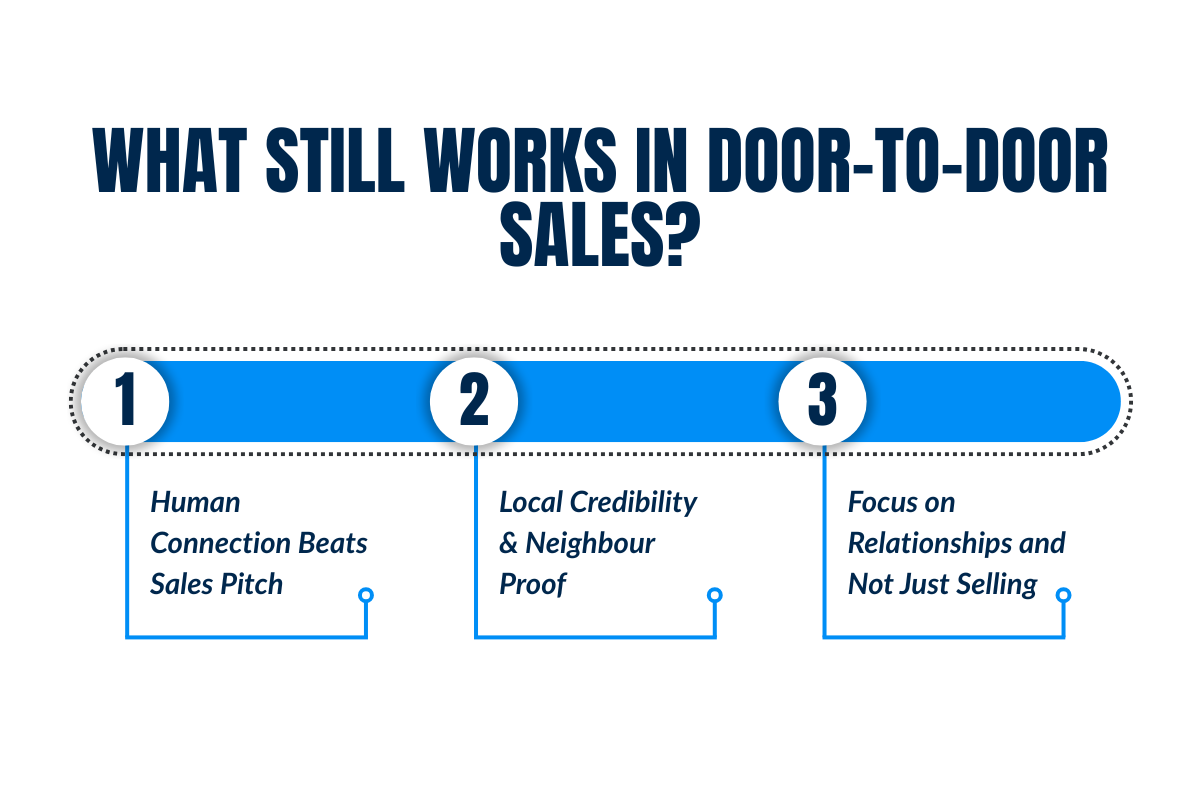
1. Human Connection Beats Sales Pitch
In the age of the AI-driven era, where every pitch feels like a bot, the human touch in D2D builds relationships where potential customers feel heard, seen, and valued, where they can share and talk through real conversations, fostering authenticity and lasting trust.
2. Local Credibility & Neighbour Proof
Nothing builds trust faster than familiarity. When homeowners see that their neighbors have already chosen your service and are satisfied with the results, skepticism naturally decreases.
Real proof of work within the same street or community creates social validation that no pitch can replicate. A visible installation, a yard sign, or a nearby reference customer signals safety, reliability, and legitimacy
3. Focus on Relationships and Not Just Selling
The key to every successful door is the rapport field sales reps build with prospects by reading their body language and expressions to spot their interests and hesitations.
D2D reps actively listen to their pain points, helping you tailor your pitch to deliver real value and solve actual problems. The goal isn’t a one-off sale but to build long-term customer relationships that lead to future sales.
The Modern D2D Sales Stack for Best Door Sales
Winning in 2026 requires more than confidence at the door. Modern D2D success comes from combining conversation skills with systems, structure, and smart execution.
1. Lead With “Why,” Not the Pitch
Modern homeowners decide within seconds whether to engage or not. Leading with a generic product pitch immediately creates resistance.
Start with relevance instead. A strong opener explains why you are there and why it matters to that specific homeowner.
Open-ended questions uncover pain points quickly and shift the interaction from selling to problem-solving. When the homeowner feels heard, objections become discussions rather than shutdowns.
2. Timing, Territory & Targeting Matter More Than Volume
Random knocking wastes energy. Without structured territory planning, reps burn fuel, repeat low-converting streets, and exhaust themselves chasing low-intent doors.
High-performing teams use mapped territories, historical conversion data, and optimal knocking windows to increase productivity per hour. When timing and targeting are intentional, conversion rates improve without increasing effort.
3. Blend Digital and Physical Touchpoints
The door knock is only the beginning. Modern D2D blends in-person conversations with digital follow-up to maintain momentum after the interaction ends.
QR codes, personalized landing pages, SMS check-ins, and automated reminders keep the conversation alive without pressure. When physical presence is supported by digital continuity, deals move forward instead of fading out.
4. Tools Built for Field Sales Professionals
Clipboards and scattered notes cannot support scalable performance. Modern door sales canvassing teams rely on canvassing software designed specifically for field execution.
These tools provide real-time lead tracking, territory visibility, route optimization, and automated follow-up systems. Managers gain transparency into daily activity, while reps stay focused on conversations instead of admin work. When systems support selling, performance becomes consistent rather than accidental.
What a High-Converting Modern D2D Script Looks Like in 2026?
A strong door-to-door script in 2026 is structured but natural. It guides the conversation without sounding rehearsed, and it prioritizes qualification, relevance, and momentum over pressure.
Here is the framework high-performing reps follow:
- Clear, Respectful Opening: Start with a brief introduction and a relevant reason for being there. Signal that you value the homeowner’s time and transition quickly into a question instead of a pitch.
- Qualify Before You Explain: Confirm homeowner status, interest level, and timing before diving into details. This protects your energy and ensures you invest time only where there is real potential.
- Lead With the Problem, Not the Product: Anchor the conversation around a pain point the homeowner mentions. Position your solution as a response to that issue rather than listing features prematurely.
- Use Open-Ended Discovery Questions: Ask questions that invite explanation instead of yes-or-no answers. This uncovers motivation, objections, and buying signals early in the interaction.
- Sell the Next Step, Not the Full Deal: Focus on micro-commitments like booking an inspection or scheduling a review. Smaller commitments feel safer and maintain forward momentum.
- Handle Objections Calmly and Briefly: Respond with curiosity instead of defensiveness. Clarify whether the hesitation is about timing, budget, or trust, then adjust or exit professionally.
- End with a Clean, Professional Exit: Not every door converts, and that is normal. A respectful closing protects brand perception and keeps the possibility of future engagement open.
How Knockbase Supercharges Door-to-Door Sales Teams To Adopt Evolving D2D Landscape?
Knockbase is an all-in-one door-to-door sales platform designed to make modern D2D teams smarter, faster, and more effective. Let's uncover how Knockbase boosts the door-to-door workflow:
- Operational Clarity: Knockbase organizes leads, optimizes routes, and allows field reps to instantly update job progress and customer notes through a mobile app. This helps teams prioritize high-value areas while managers refine strategies using real-time insights.
- Sales Simplified at every stage: Knockbase boosts D2D sales by helping teams plan smarter routes, organize leads centrally, capture notes instantly during customer visits, and automate follow-ups effortlessly.
- Insights to view Results to Drive Conversions: Knockbase provides clear, measurable insights into sales progress, performance tracking, and financial analysis, helping managers make informed decisions as metrics reveal what works and what needs adjusting to boost conversions.
Knockbase Features That Simplify Modern D2D Work
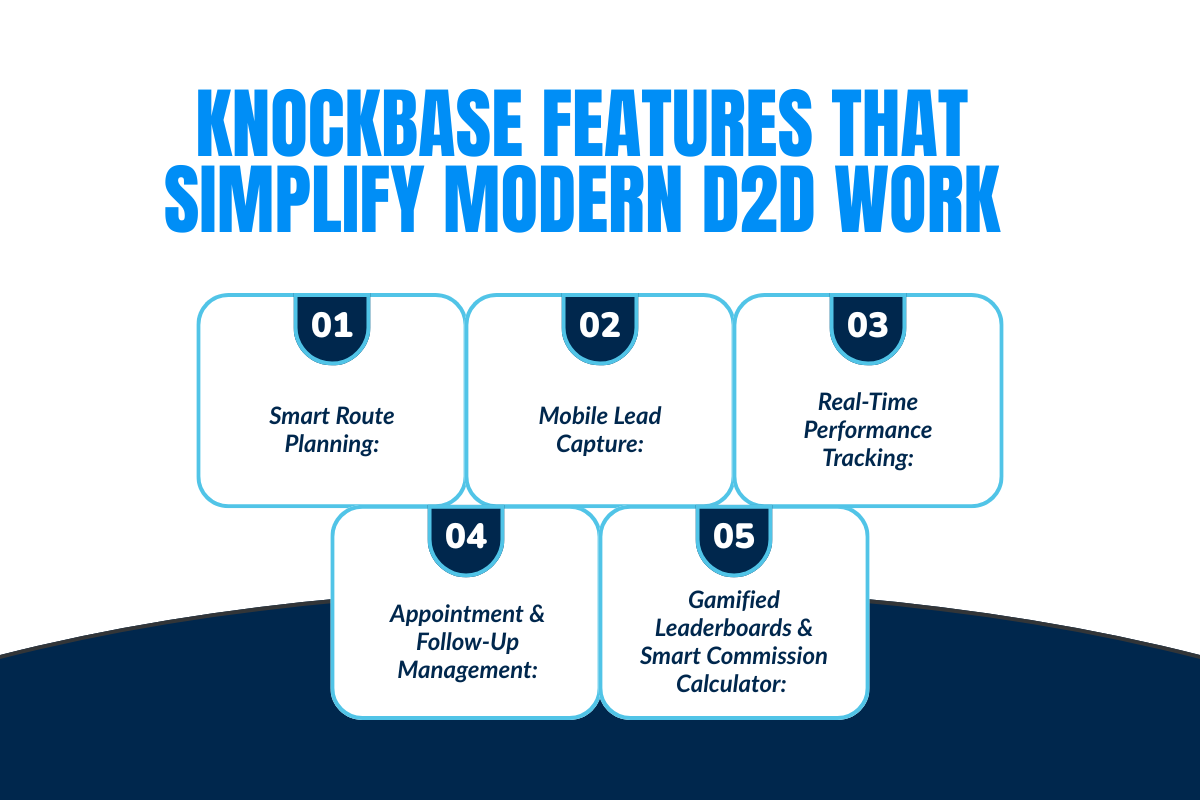
1. Smart Route Planning:
It automates canvassing routes based on real-time leads and upcoming services, ensuring the shortest paths that cover the maximum number of doors for each field rep, with instant re-routing in case of weather or traffic disruptions.
2. Mobile Lead Capture:
An integrated mobile app helps sales reps capture and view job status, progress, customer details, and job notes on the go, eliminating delays that lead to lost opportunities due to forgotten notes and manual data entry.
3. Real-Time Performance Tracking:
Live dashboards help view and analyze financial performance, field rep performance, conversion rates, average deal size, and ROI to identify and resolve bottlenecks and achieve door-to-door sales success.
4. Appointment & Follow-Up Management:
Automation notifications through SMS, email, and in-app reminders support upcoming appointments, follow-ups for potential leads, and service renewal reminders to help increase closed deals.
5. Gamified Leaderboards & Smart Commission Calculator:
Live progress reports update instantly to showcase each sales rep’s performance using points, badges, and rewards. With constant visibility, reps stay alert, motivated, and driven to outperform others and climb the leaderboard as top performers.
The commission tool pulls data directly from the CRM to calculate commissions for every sales rep based on their performance output.
Final Takeaway:
Approach each customer with the idea of helping him or her solve a problem or achieve a goal, not of selling a product or service: Brian Tracy
This philosophy perfectly fits modern door-knocking. In a world where digital ads are scrolled past, popping up at every door like a problem solver with solutions tailored to each customer, adds real value.
Mix in smart technology with the timeless traditions of door-to-door selling, and you get to knock on the right doors at the right time, where even the smallest conversation can turn into a big win.
Upgrade Your Door-to-Door Strategy for 2026
If your team is still relying on volume, memory, and manual follow-up, now is the time to rethink the process behind the knock. Equip your field team with structured routing, real-time tracking, and disciplined follow-up systems that protect every opportunity.
Book your 15-minute Personalized Demo and level up your sales game.
Frequently Asked Questions (FAQs)
1. Why is D2D so Hard?
Door-to-door sales are challenging due to high rejection rates, safety concerns, and commission-based pay, where widespread public skepticism about door sales reps makes income unpredictable and places intense pressure on salespeople.
2. Is Door-to-Door Sales a Good Idea?
Door-to-door sales can be effective for capturing local markets in home service businesses like solar panels or roofing, home security systems, pest control, and HVAC services, where people are open to in-person engagement. It enables reps to build rapport, create personal connections, and conduct quick on-site assessments, making it best suited for resilient, motivated professionals comfortable with commission-based earnings.
3. What is the Success Rate of Door-to-Door Sales?
The average door-to-door sales success rate is around 2–5%, varying by product, sales tactics, lead quality, and the door salesperson's ability to handle objections. Top-performing sales reps, however, have reported success rates of 20% or more.
4. What is the 3-3-3 Rule in Door-to-Door Sales?
The 3-second rule is a popular framework in door-to-door selling that assigns clear time limits to each stage of the sales approach:
- 3 seconds to grab a potential customer’s attention with an intriguing opening hook
- 3 minutes to build a positive impression and establish credibility and trust
- 3 days for a prompt follow-up to strengthen the chances of closing the deal
5. What are the Biggest Challenges of D2D today?
Persistent customer resistance, mistrust, and lack of interest create major challenges in the door-to-door sales process. Inefficient routing and intense competition further add to the difficulties faced by field sales teams.