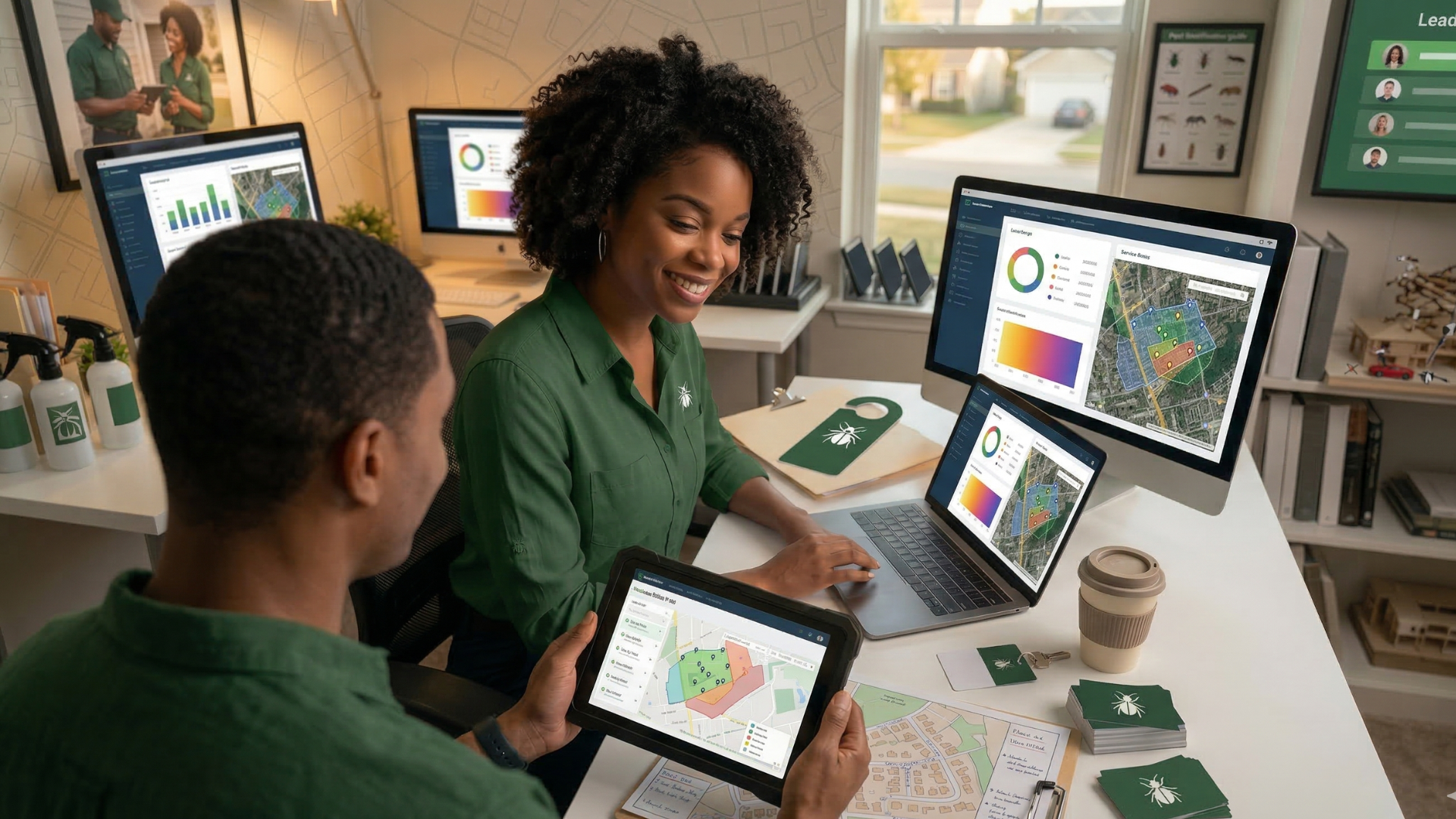
Door-to-door sales reward momentum, and every delay after the first conversation, missed follow-ups, forgotten notes, and unclear lead ownership reduce the chance of closing.
Door-to-door salespeople move fast, but manual tracking and fragmented tools slow them down. Also, when teams rely on memory rather than systems, the sales process breaks down before potential customers are ready to make a decision.
Now, top door sales teams win this because their field sales process is structured, repeatable, and built for speed.
Therefore, in this blog, we'll break down the systems, workflows, and door sales tips that help D2D teams close more deals, reduce lead drop-off, and scale consistently, without burning out their salespeople.
Building Scalable D2D Sales Systems for Door-to-Door Growth
Building scalable D2D sales systems is essential for teams running high-volume door-to-door sales. Unlike generic sales tools, D2D sales systems are designed around practical door sales workflows, supporting the full sales process from first knock to close.
In short, structured D2D sales platforms enable repeatable door-to-door selling, while generic tools require heavy workarounds and still fail to support the speed, visibility, and discipline needed for sustainable door-to-door growth.
Key Takeaways
- Door-to-door sales success depends on structured sales efforts, not just individual performance from door salespeople.
- Consistent follow-up helps teams convert more potential customers while interest is still high.
- Strong sales strategies keep door sales teams aligned, ensuring a clear and repeatable sales process.
- Effective door-to-door selling relies on defined sales techniques that help field sales teams track conversations and next steps.
- High-performing D2D sales teams simplify door sales operations so sales representatives can focus on selling, not admin work.
Ready to put these strategies into practice?
Book a demo to see how Knockbase streamlines D2D sales, automates follow-ups, tracks leads, and gives your door-to-door teams the visibility and structure they need to close more deals.
Why Door-to-Door Sales Performance Breaks When Teams Scale?
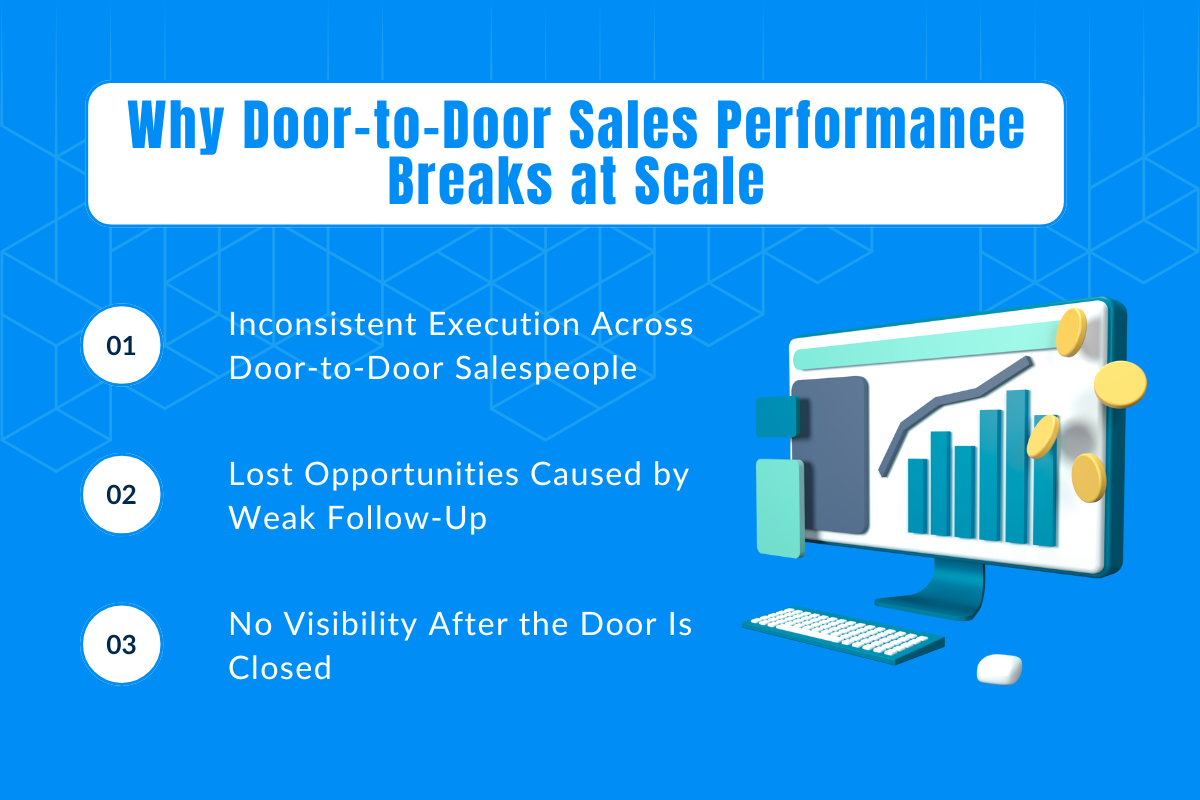
As door-to-door sales teams grow, maintaining consistency becomes harder. What works with a small group often breaks down when execution depends on individual habits rather than shared systems. Without structure, door selling becomes unpredictable and difficult to scale.
1. Inconsistent Execution Across Door-to-Door Salespeople
When there’s no clear structure in place, every door-to-door salesperson ends up creating their own version of the process.
One rep might open confidently with a strong introduction, while another struggles to set the tone. Some handle objections calmly and guide the conversation forward, while others get stuck or move on too quickly. Even the definition of what qualifies as a “great door” can vary from person to person.
Over time, this inconsistency creates uneven performance across the team. Results depend more on individual style than on a shared system, making it difficult to scale success or coach effectively.
2. Lost Opportunities Caused by Weak Follow-Up
A strong door sales conversation means very little if nothing happens afterward. In many teams, follow-up depends on the rep remembering to call, text, or revisit, and that’s where momentum dies.
When there’s no structured system guiding next steps, even high-intent prospects quietly fade away. Timing gets missed or delayed, and no one clearly owns the next action.
What started as a promising conversation turns into silence because relationship-building stops after the first interaction. Over time, these small gaps compound into lost revenue that never shows up on a report
3. No Visibility After the Door Is Closed
Once the door shuts, many teams lose sight of what happens next. Managers have no clear way of knowing which conversations are progressing, which are stalled, and which need intervention. Without visibility, performance becomes reactive instead of intentional.
Teams miss the opportunity to improve body language, refine product explanations, or adjust door sales techniques based on real patterns. Without insight, growth relies on guesswork instead of measurable improvement.
System vs Talent in Modern Door Selling
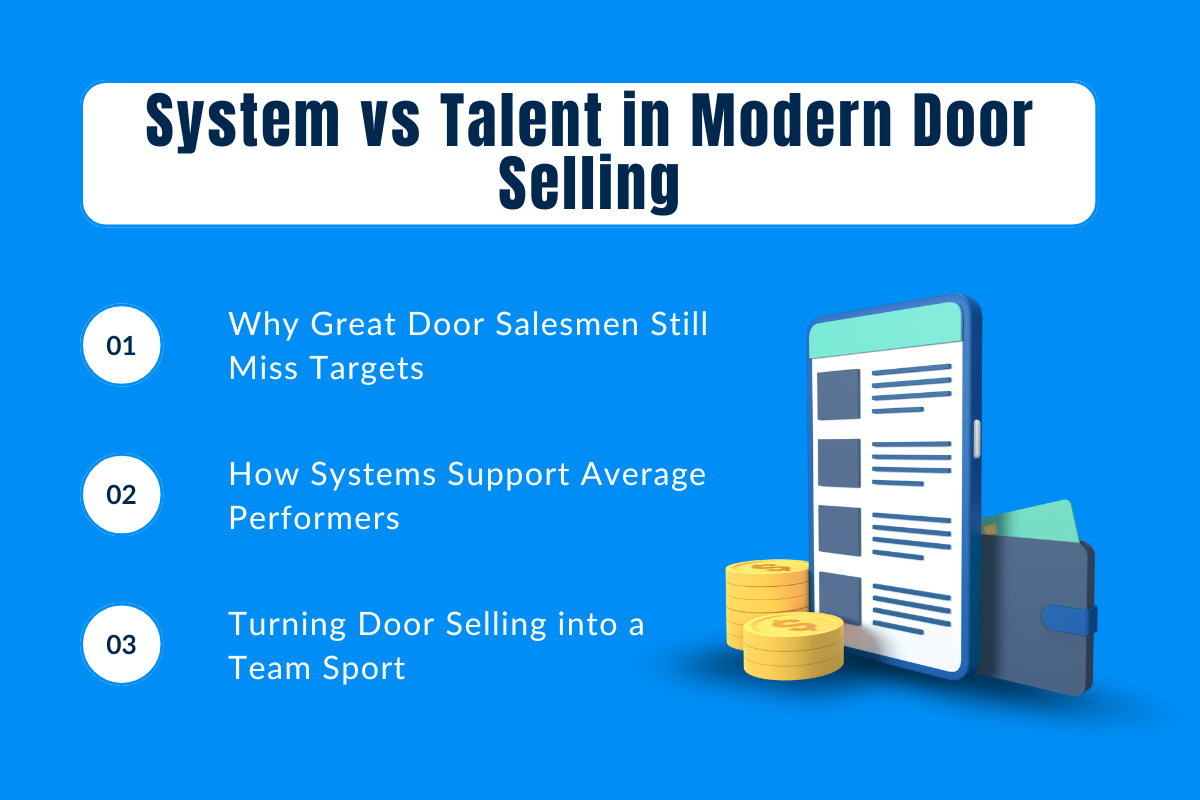
Great door salesmen still exist, but in modern door selling, talent alone is no longer enough. As teams scale, relying on individual skill creates uneven performance, missed follow-ups, and fragile results. Systems don’t replace talent; they amplify it.
1. Why Great Door Salesmen Still Miss Targets
Even experienced door-to-door salespeople fall short when execution relies on memory rather than structure.
- Skill without process: Strong communication fades when next steps aren’t clearly defined
- Memory-driven selling: Follow-ups, objections, and details get lost between doors
- Inconsistent openers and closers: What works one day doesn’t always repeat the next
Just like a weak opening line confuses homeowners, unclear processes confuse sales reps, leading to missed opportunities.
2. How Systems Support Average Performers
Not every rep starts as a top performer, and that’s okay. Systems create clarity where experience is missing.
- Step-by-step door sales execution: Clear actions from first knock to follow-up
- Reduced learning curve: New reps know exactly what to say, do, and track
- Built-in confidence: Structure removes hesitation and second-guessing
Much like a clear opener helps homeowners understand why you’re there, systems help sales reps understand what success looks like at every door.
3. Turning Door Selling into a Team Sport
Door selling fails when success lives only in one person’s head. Systems make performance shared, measurable, and repeatable.
- Shared processes: Every rep follows the same playbook
- Measurable outcomes: Teams can see what’s working and what’s not
- Scalable execution: Growth doesn’t break quality or consistency
When everyone follows the same structure, results improve across the board, not just for the “best door” salespeople.
Core Components of High-Performing D2D Sales Systems
So what separates high-performing door sales teams from those constantly chasing numbers?
It’s not louder sales pitches or more aggressive door knocking. It’s systems that shape how reps prepare for a territory, how conversations are handled at the door, and how follow-ups are executed afterward.
Let’s break down the core components that make modern door-to-door sales work consistently.
1. Structured Door-to-Door Selling Workflows
Ever noticed how top performers seem to move effortlessly from one door to the next? That’s not luck, it’s structure.
A strong door-to-door sales workflow creates a clear, repeatable path from the first knock to follow-up. Every door interaction has intent, not guesswork.
This means door salespeople always know:
- How to open the conversation with clarity
- When to ask questions versus when to listen
- What is the next step before leaving the door
When workflows are defined, even average door salespeople can deliver a consistent personal touch. The result is better conversations, fewer dropped opportunities, and a clearer understanding of what actually moves deals forward.
2. Follow-Up Discipline That Wins More Door Sales
Strong conversations often lead to nothing, simply because follow-up is delayed, inconsistent, or forgotten. High-performing D2D systems remove reliance on memory and build follow-up into the process itself.
So what changes?
- Follow-ups happen at the right time, not “when I remember.”
- Promising leads don’t go cold
- Sales teams stay accountable without micromanagement
This discipline is hugely beneficial when selling high-consideration products like solar panels or services that require trust. Consistent follow-up respects the homeowner’s valuable time while keeping your brand top of mind.
3. Sales Pipeline Visibility for Door Sales Teams
Once the door closes, most managers lose visibility, and that’s where deals stall.
Pipeline visibility gives sales teams real-time clarity into what’s happening across territories. Instead of guessing, teams can see exactly where each opportunity stands.
This answers critical questions:
- Which doors turned into new leads?
- Which follow-ups are overdue?
- Where are deals getting stuck?
With visibility, door-to-door sales teams prioritize the right actions, coach more effectively, and close faster. It also helps scale across other businesses and regions without losing control.
4. Coaching and Feedback Loops for Door-to-Door Salespeople
High-performing systems use real performance data to improve skills, not just outcomes. This allows managers to move beyond “sell better” advice and give actionable feedback.
Effective coaching focuses on:
- Opening lines that create instant clarity
- Body language, eye contact, and confidence at the door
- How well reps adapt their sales pitch to the target audience
Over time, this creates a team of top performers, not just one standout door salesman. Skills improve, success rates rise, and best practices are shared rather than isolated.
Why This Matters for Modern D2D Teams
Homeowners aren’t evaluating your full product offering when they open the door. They’re deciding:
- Do I trust this person?
- Is this worth my time?
Systems help door salespeople pass these tests more consistently. They lead to better conversations, stronger relationships, more new leads, and a growing customer base, without relying solely on individual talent.
The Role of Body Language and Process in Door Sales
In-door sales, impressions are formed in mere seconds. Before the pitch even begins, customers respond to posture, tone, and presence. But body language delivers real results only when it’s guided by a repeatable process.
1. How Body Language Works Best Inside a System
A system gives salespeople clarity on how to show confidence, when to lean in, and when to pause, turning every door interaction into a controlled, professional conversation.
> Reinforcing Confidence Through Repeatable Interactions
Confidence at the door is built through consistency. When interactions follow a repeatable process, sales reps know exactly how to show up, every single time.
Standardized workflows help by:
- Creating a calm, controlled posture and steady eye contact at the door
- Maintaining a clear, confident tone regardless of experience level
- Reducing hesitation before benefits or services are introduced
- Building early trust with prospects within the first few seconds
Over time, this structured repetition leads to a more predictable success rate across sales teams, instead of relying on occasional wins from one standout door salesman.
> Aligning Non-Verbal Cues with Sales Stages
Different stages of a door conversation require different signals.
Clear stages in the sales process ensure body language supports intent:
- Open posture and relaxed tone during introductions
- Attentive listening cues while understanding customer needs
- Calm, controlled confidence during objection handling and follow-up
When non-verbal cues align with each stage, conversations feel natural, focused, and respectful, helping move more leads toward a purchase decision.
2. Why Training Alone Doesn’t Create Consistent Results
Training improves awareness, but awareness doesn’t guarantee execution. Many companies invest heavily in training, only to see performance dip weeks later.
This is simply because, without systems, even well-trained salespeople revert to habits under pressure, especially in fast-paced door-selling environments. That’s why training must be supported by tools and processes that guide behavior on the job.
> How to Prevent Skill Drop-Off After Initial Coaching
Process-driven systems help by:
- Reinforcing good habits through checkpoints and reminders
- Supporting consistent follow-ups after door conversations
- Reducing reliance on memory in fast-moving door-to-door roles
- Maintaining deal quality across varied customer interactions
When training is backed by process, teams stay focused, execution stays consistent, and performance improves over time, without constant retraining.
Building a Sustainable Customer Base Through Door Sales
Door-to-door sales isn’t only about closing deals at the door. Long-term success comes from turning everyday conversations into relationships that continue well beyond the first interaction.
When door-to-door salespeople operate with structure and intent, each door becomes an opportunity to build trust, not just push a pitch.
1. Creating Consistency Instead of One-Off Wins
A consistent door-to-door approach helps teams show up with the same clarity, confidence, and message at every door. Over time, this consistency improves success rates across the team, not just for top performers.
2. Driving Long-Term Value with Disciplined Door Sales
Not every door interaction leads to an immediate “yes.” But disciplined door selling ensures that interested prospects don’t disappear after the first conversation.
With standardized workflows and follow-up practices, companies can:
- Stay connected with prospects who need more time
- Build trust through timely, relevant follow-ups
- Position services as helpful solutions, not pushy sales pitches
- Grow a reliable customer base that supports long-term business success
In industries, disciplined door-to-door sales isn’t just about today’s job, it’s about creating lasting value for both the company and the customers it serves.
Manual Door Selling vs System-Driven D2D Sales
What works for one great door salesman often breaks when the team grows. This comparison highlights the core difference between relying on individual habits and building a system that supports consistent door-to-door sales performance at scale.
| Area | Traditional Door Selling | System-Driven D2D Sales |
|---|---|---|
| Lead handling | Notes, memory, or paper-based tracking | Centralized digital lead tracking |
| Follow-up execution | Rep-dependent and often inconsistent | Automated and process-driven follow-up |
| Result consistency | Varies widely by salesperson | Predictable outcomes across sales teams |
| Team growth | Difficult to scale without performance drops | Built to support structured team expansion |
| Performance visibility | Limited insight after the door interaction | Data-backed visibility into every deal stage |
Where Technology Fits into Modern D2D Sales?
Modern D2D sales are no longer just about a few top performers carrying the numbers. As teams grow, relying on individual memory, personal style, or ad-hoc follow-up creates gaps that are hard to see and even harder to fix.
Technology fills this gap by giving door sales teams a shared structure that supports every rep, every conversation, and every territory.
1. Structured Digital Workflows Replace Memory-Based Selling
Technology creates defined stages inside the sales process. Every knock moves through a clear path:
Knocked → Engaged → Qualified → Follow-Up Scheduled → Closed
Reps no longer decide what happens next based on instinct. The system defines required actions, timestamps, and ownership. This eliminates forgotten next steps and inconsistent execution.
2. Centralized Lead Intelligence Replaces Scattered Notes
Instead of paper notes, WhatsApp messages, or mental tracking, every door interaction is logged in one place.
Technology captures the outcome of each door, objections raised, customer interest level, follow-up timing, and territory activity. This creates a live operating dashboard instead of end-of-day guesswork.
Managers no longer ask, “What happened today?” They can see it.
3. Automated Follow-Up Removes Revenue Leakage
Inconsistent follow-up is one of the biggest sources of lost D2D revenue. Technology enforces discipline by:
- Triggering reminders automatically
- Assigning ownership clearly
- Escalating overdue follow-ups
- Tracking completion rates
These shifts follow up from optional behavior to measurable execution.
4. Real-Time Territory Visibility Prevents Coverage Gaps
As teams expand, territory imbalance becomes common. Some areas are overworked. Others are untouched.
Technology enables:
- Geo-tagged knocking
- Live territory heat maps
- Coverage tracking
- Rep distribution optimization
Leaders can adjust routes the same day, not weeks later. Scaling becomes controlled instead of chaotic.
5. Performance Analytics Connect Activity to Conversion
Activity alone does not equal performance. Technology connects effort to outcomes. Instead of tracking “doors knocked,” modern D2D systems track:
- Knock-to-conversation rate
- Conversation-to-appointment rate
- Appointment-to-close rate
- Follow-up completion ratio
- Conversion by territory
This shifts leadership conversations from motivation to measurable improvement.
How Knockbase Supports D2D Sales Teams?
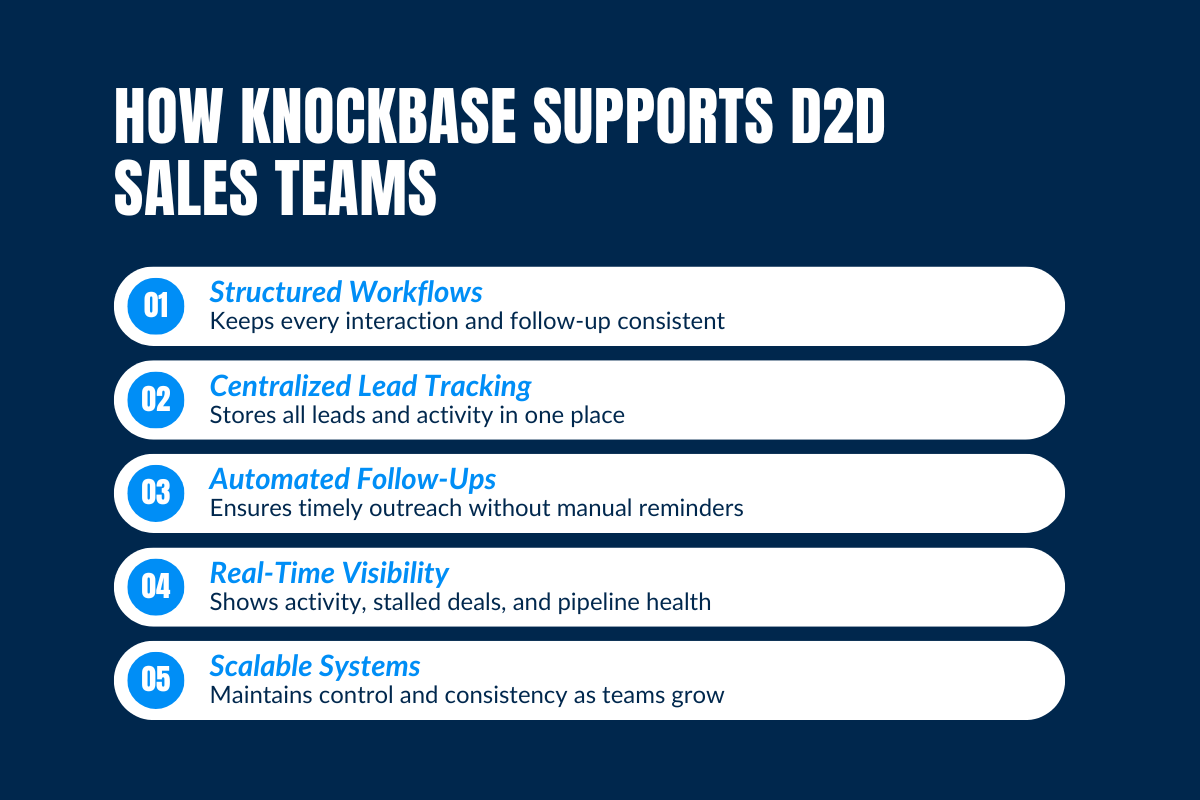
Knockbase is designed to strengthen D2D sales operations by bringing structure, visibility, and scalability into one system. Instead of changing how teams sell, it supports consistent execution across every stage of the sales journey, from the first knock to follow-up and closure.
By replacing manual tracking and fragmented tools with a centralized platform, Knockbase helps teams operate more efficiently while maintaining accountability and predictable results as they grow.
Built for consistency and scale, Knockbase helps D2D teams close more leads while building a sustainable customer base.
Key capabilities include:
- Structured Workflows - Step-by-step guidance keeps interactions consistent and ensures every lead gets proper follow-up.
- Centralized Lead and Activity Tracking - All lead data and interactions live in one place for better organization and real-time action.
- Automated Follow-Ups - Reminders and alerts help teams follow up on time without relying on memory.
- Real-Time Visibility and Reporting - Instant insights into activity, stalled deals, and pipeline health support faster decisions.
- Scalable Systems for Growing Teams - Supports expansion across territories and new hires while maintaining control and consistency.
- CRM & System Integrations - Knockbase connects with existing CRM tools, so data flows without double entry. Approved deals move smoothly into onboarding, fulfillment, or installation workflows.
Final thoughts
Door-to-door sales isn’t just about talent; it’s about systems, structure, and consistent execution. While top performers can succeed on instinct, scaling a D2D team requires repeatable workflows, clear accountability, and data-driven insights.
When process and people work together, teams close more deals, build stronger customer relationships, and grow a sustainable customer base, without relying on guesswork or memory. Investing in structured D2D sales systems isn’t optional; it’s how modern teams win consistently.
Ready to Level Up Your Door-to-Door Sales Performance?
Move beyond guesswork with structured lead tracking, automated follow-ups, and clear visibility across every deal.
Book a demo to see how your team can close more doors and scale with confidence.
FAQs
1. What are D2D sales, and why are they important?
Door-to-door (D2D) sales is a method where sales reps engage potential customers directly at their homes or businesses. It’s important for building personal connections, generating new leads, and effectively expanding your customer base.
2. How can I improve my door-to-door sales performance?
Improving D2D sales performance requires structured workflows, consistent follow-ups, understanding customer needs, effective body language, and tracking results with technology like Knockbase.
3. What makes a D2D sales system better than relying on talent alone?
While talented salespeople can close deals, system-driven D2D sales ensure consistency, scalability, and accountability. It reduces reliance on memory or individual skills and improves overall team success.
4. How do I train door-to-door salespeople effectively?
Combine hands-on coaching with structured workflows. Focus on opening lines, objection handling, body language, and follow-up discipline, while reinforcing skills through technology and process-driven reminders.
5. What is the 3-3-3 rule in sales?
The 3-3-3 rule is a guideline for door-to-door selling. Spend the first 3 seconds making a strong first impression, use the next 3 minutes to engage and understand the prospect, and aim for a 3-point value pitch that highlights key benefits quickly. It helps reps stay focused, respect the prospect’s time, and increase conversion.
6. What is the success rate of a door-to-door salesman?
Success rates vary by industry, territory, and skill, but structured D2D sales systems significantly improve results. Top-performing door salespeople in organized teams can convert 15–30% of leads, compared to single-digit conversion for reps relying on memory or unstructured approaches.