For years, door-to-door sales training has followed a familiar pattern: shadow a top rep, memorize a script, and learn the rest on the job.
In 2026, that approach is showing clear cracks. Poor onboarding now leads directly to higher churn, lower conversion rates, and early burnout among new reps.
At the same time, the field itself has changed as buyers are more informed, regulations are tighter, and reps expect clearer structure and support.
If traditional training models are no longer keeping up, the real question is what does effective, modern D2D enablement actually look like today?
D2D Sales Training in 2026: What Actually Works for Modern Door-to-Door Teams
This guide breaks down how high-performing door-to-door teams train reps in 2026 using repeatable systems rather than ad-hoc coaching.
It explains the specific skills that separate top reps from average ones, how modern enablement accelerates ramp-up without burnout, and how field technology turns daily activity into actionable coaching insights.
The article also outlines a practical 30-60-90 day training framework, measurable indicators of training effectiveness, and how teams can audit and improve their current onboarding and enablement processes.
Key Takeaways
- Modern door-to-door training helps teams discover what actually works in the field by focusing on behavior rather than theory.
- Faster ramp-up comes from structure and systems, not pressure or information overload.
- Effective enablement improves rep retention and helps teams protect time, energy, and money.
- Technology supports training best when it reinforces coaching instead of replacing it.
- The goal of modern training is consistency and putting repeatable processes behind daily field activity.
- Teams looking to modernize should start with practical, field-tested tips.
See Knockbase in Action
If you want to understand how these training systems work in real field conditions, see how teams use Knockbase to turn daily activity into coachable insights. Book a demo to explore how modern enablement fits into your existing workflows.
Why is Traditional Door-to-Door Sales Training Failing New Reps in 2026?
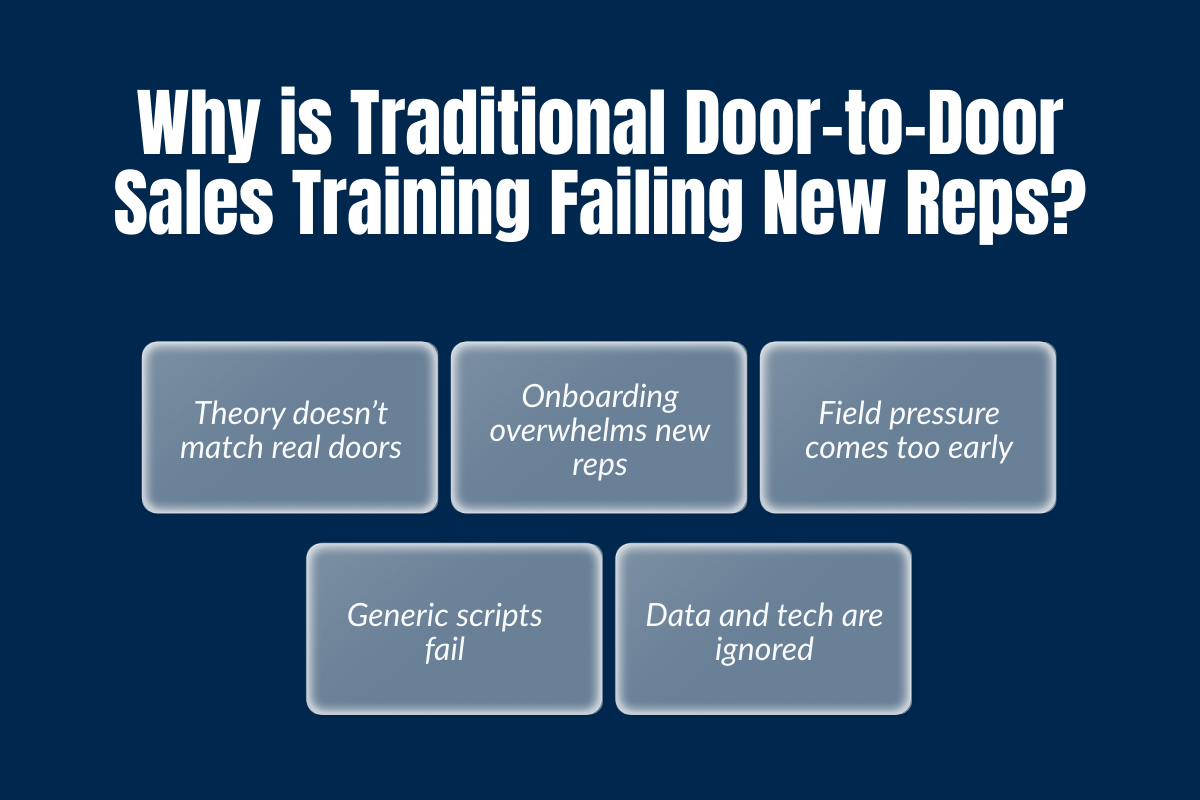
In 2026, buyer behavior has changed significantly, so your sales rep training needs to be updated, too. Don't get us wrong, but door-to-door sales still rely on communication and trust as its foundation, but you need to upgrade the pillars.
1. The Theory-Practice Gap
New reps are often trained using scripts, role explanations, and classroom-style sessions, but they receive limited opportunities to apply those concepts in realistic scenarios.
Real communications with potential customers are not staged, can't be controlled, and can't be scripted. And that's why many sales reps struggle to adapt.
2. Outdated Onboarding Practices
Lengthy meetings and manuals leave sales reps disengaged before they learn anything. The information overload at the beginning, with minimal checkpoints afterwards, is a recipe for disaster while training new D2D sales reps.
3. Quick Fieldwork Pressure
This gap is compounded by high-pressure, low-structure training models, as in many organizations, new sales reps are expected to begin fieldwork quickly with minimal guidance and product knowledge.
Performance is measured early, but coaching and feedback are inconsistent. Over time, this leads to confusion, low confidence, and higher turnover among new reps.
In fact, HubSpot reports an average rep turnover of 35 percent, which is higher than the industry average of 13 percent.
4. Generic Training Material
Another limitation is the reliance on outdated, generic training materials. Standard scripts and one-size-fits-all approaches do not account for differences in customer awareness, product complexity, or local context.
As prospects become more informed and selective, rigid training methods often fail to prepare reps for nuanced conversations and closing techniques.
5. Ignoring Tech and Data Shifts
Old playbooks and manuals ignore new trends in D2D, such as AI route planning, CRM tracking, and data-driven territories. Modern D2D also requires consultative selling, with visuals such as AR demos.
What Does “Modern Enablement” Look Like for Door-to-Door Teams?
Instead of treating training as something that happens only in the first few days, enablement becomes a continuous process that supports reps throughout their ramp-up and beyond.
1. Continuous Coaching
One key change is the move from onboarding-only training to continuous development. Rather than front-loading information, modern teams introduce skills gradually and reinforce them over time. This allows reps to apply what they learn in real situations and improve based on experience, not just theory.
This can include weekly role-plays, recorded pitch reviews, and data-backed feedback on KPIs such as contact rates (aim for a 2-5% conversion rate).
Gamified leaderboards and AutoPlays guide reps through objection handling and follow-ups, keeping them motivated.
2. Tech Stack Essentials
Teams use mobile CRMs like Knockbase or SPOTIO for smart territory mapping, real-time rep tracking, and automated workflows that cut manual data entry by 46%.
Route planners minimize walking time by 30-50%, while instant scheduling syncs calendars on-site, increasing appointment conversions.
Digital pitch tools with visuals (e.g., AR demos) and AI-assisted lead prioritization replace notebooks and guesswork.
3. Microlearning and Skill Stacking
To help sales reps with micro learning, training is broken into short, focused drills that reflect real scenarios reps encounter daily. These sessions are designed to be quick, practical, and followed by immediate feedback, making it easier for reps to retain and apply new skills.
Finally, enablement programs focus on skill stacks that reflect current field realities. These often include territory planning, handling objections in unscripted conversations, maintaining accurate data, and following up consistently.
Together, these skills help reps operate more effectively in complex and unpredictable sales environments.
But Training only works when it mirrors the real job. So what skills actually move the needle in 2026?
Which Sales Skills Separate High-Performing D2D Reps From Average Ones?
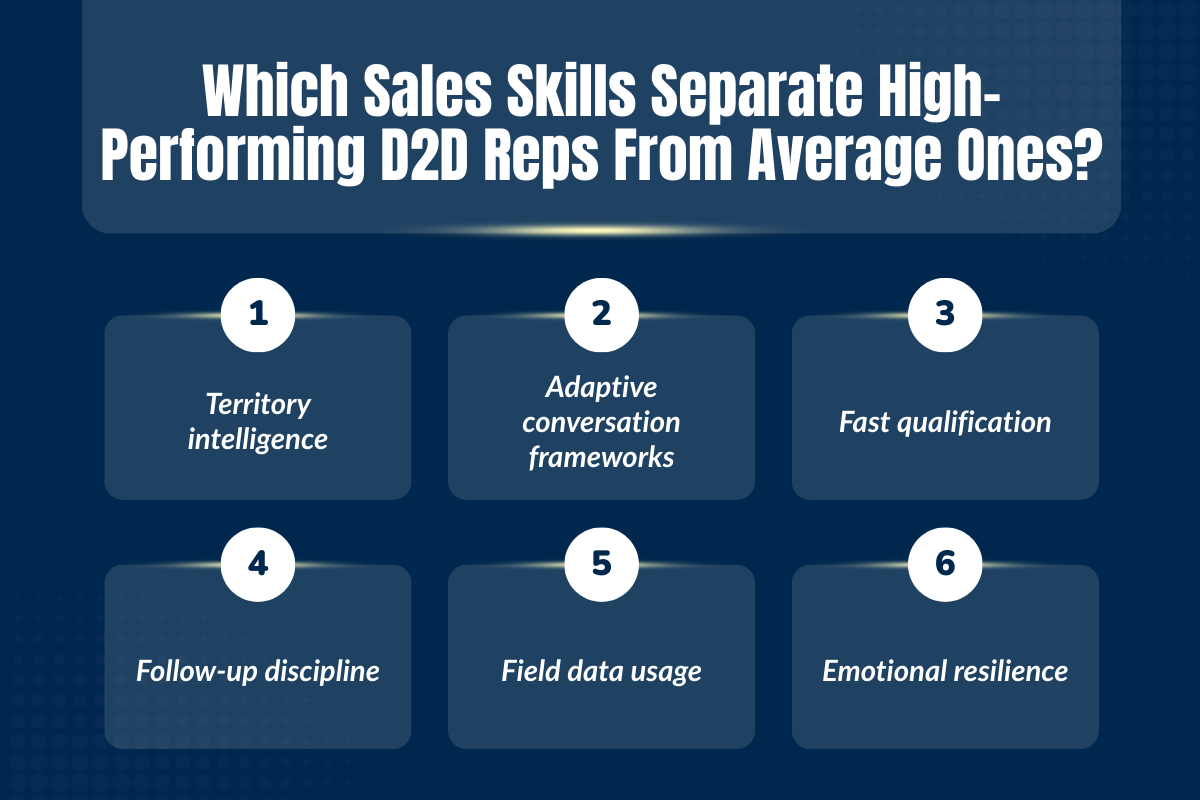
High-performing door-to-door sales representatives are not defined solely by charisma. What consistently sets them apart is a specific set of skills that help them work effectively despite rejection, time pressure, and short customer interactions.
1. Territory Intelligence: Knowing Where to Knock, Not Just How
Top-performing reps spend time understanding their territory before they start knocking. Instead of treating every door the same, they look for patterns in household types, prior responses, time-of-day effectiveness, and neighborhood-level signals.
This allows them to prioritize areas where conversations are more likely to convert, improving both efficiency and morale.
For teams systematically building this skill, territory mapping for D2D route planning is one of the simplest ways to reduce wasted knocks and improve consistency.
2. Conversation Frameworks Over Rigid Sales Pitch
Average reps often rely on memorized scripts, which break down when conversations deviate from expectations. But High performers use flexible conversation frameworks instead.
These frameworks help them guide discussions while adapting to different customer responses, making interactions feel more natural and relevant during brief doorstep conversations.
3. Fast Qualification: Identifying Intent Within the First Minute
Because door-to-door interactions are short, strong reps quickly assess whether a prospect has real intent.
They listen for verbal and behavioral cues, interest level, objections, urgency, and decision authority, often within the first 30–60 seconds.
This ability prevents wasted time and helps reps focus their energy on the highest-payoff activities.
4. Follow-Up Mastery: Converting “Maybe Later” Into Action
Many prospects are not ready to commit during the first interaction. High-performing reps, on the other hand, treat follow-up as a core skill rather than an afterthought.
They capture accurate notes, schedule timely next steps, and maintain discipline in follow-through. This turns initial hesitation into booked appointments or future conversations.
5. Using Field Data for Improvement, Not Just Reporting
Top reps actively review their own field data knock counts, response patterns, objections encountered, and outcomes.
Instead of viewing data solely for management, they use it to refine their approach, adjust timing, and identify where they lose momentum in conversations.
6. Emotional Stamina: Handling Rejection Without Burnout
Rejection is a constant in door-to-door sales, and high performers differ in how they process it. They understand that rejection is rarely personal and often driven by timing, context, or customer priorities.
By separating outcomes from self-worth, they maintain motivation even after multiple rejections and avoid burnout over long selling cycles.
| Sales Skill | What It Enables |
|---|---|
| Territory intelligence | Focuses effort on higher-intent areas instead of random knocking |
| Adaptive conversations | Handles real customer responses without relying on rigid scripts |
| Fast qualification | Identifies genuine interest within the first 30–60 seconds |
| Follow-up discipline | Converts initial hesitation into scheduled next steps |
| Field data usage | Improves performance through self-review, not just reporting |
| Emotional stamina | Sustains motivation despite frequent rejection |
How Can Teams Train Reps Faster Without Burning Them Out?
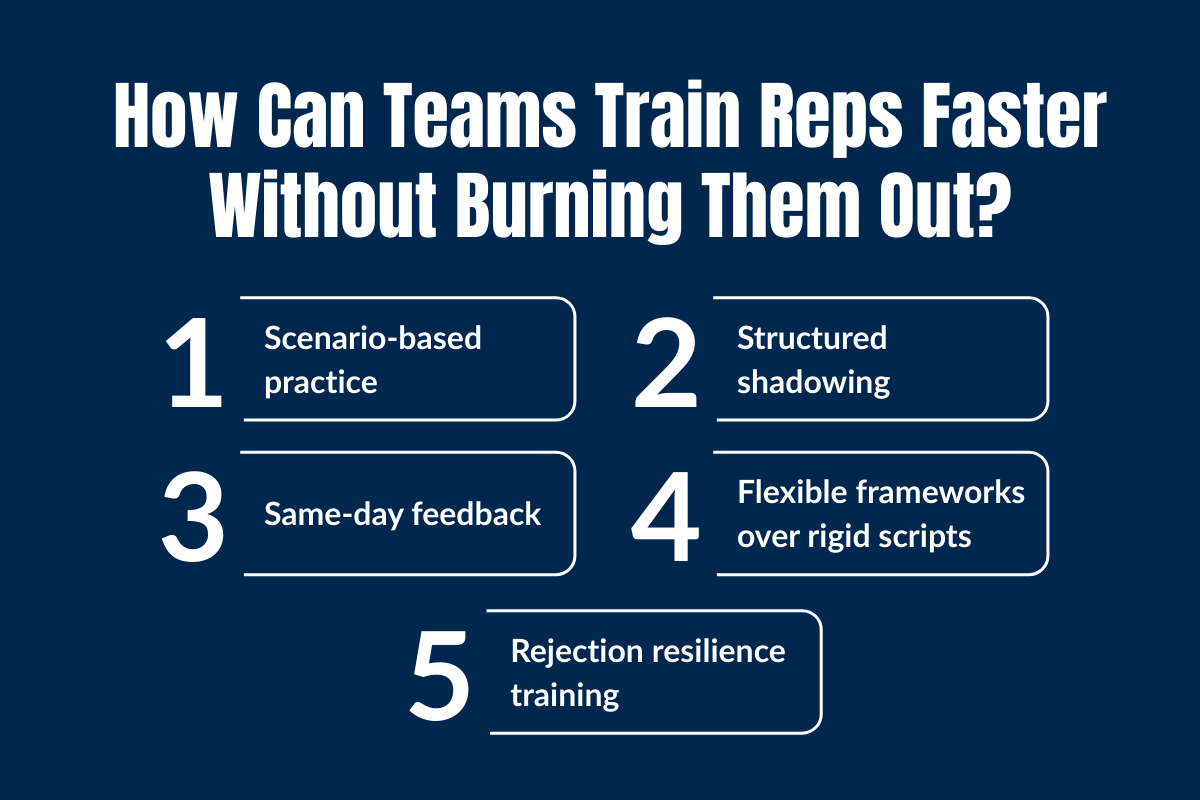
Faster ramp-up in door-to-door sales doesn’t come from adding more training content. It comes from structured learning, so reps can apply skills immediately without overload.
1. Replace Information Dumps With Scenario-Based Learning
Instead of long classroom sessions, effective programs use short drills built around real doorstep moments, such as introductions, objection handling, and closing or setting next steps.
Role-plays and simulations help reps practice understanding customer needs during brief interactions, then refine their approach through feedback.
2. Shadowing Done Right: What Sales Reps Should Observe
Shadowing works best when it has a checklist. New reps should actively observe how top reps open conversations, ask effective questions, handle rejection, and decide when to close versus schedule follow-up.
Combining classroom-style learning with structured field ride-alongs builds confidence faster than “watch and copy” training.
3. Field Coaching Loops: Review, Apply, Improve
High-performing teams use simple coaching loops. Reps review recent interactions, apply targeted feedback in the field, and reassess outcomes.
One-on-one coaching is especially useful here because it targets individual gaps, questioning, qualification, or closing, without overwhelming the rep with too many changes at once.
4. Same-Day Feedback to Reinforce Learning
Same-day feedback shortens and strengthens the learning cycle. Quick debriefs after a route or ride-along help reps correct mistakes before they become habits and protect motivation after multiple “no’s".
5. Use Scripts as Training Wheels, Not a Crutch
Scripts and pitches can help new reps get started, but they should be treated as scaffolding. Reps ramp faster when teams teach flexible frameworks, how to ask, listen, and adapt, rather than forcing rigid wording that breaks under real objections.
6. Train for Rejection Resilience (Burnout Prevention)
Rejection is a core part of door-to-door sales, which is why training should normalize rejection early, teach reps not to take it personally, and give practical routines to reset between doors. This is one of the most direct ways to reduce burnout and early churn.
7. Teach the Tools That Support the Field
Many teams now train reps on field sales software (e.g., Knockbase or SalesRabbit) for territory management and lead tracking.
When used properly, tools improve time management and follow-up discipline, so reps spend more time on high-value conversations and less time losing leads.
To train a door-to-door sales team without burning time, you need to redesign practice and coaching loops in a field-first setup and think beyond theory.
How Field Tech Is Quietly Becoming the Backbone of D2D Sales Training?
Field technology is changing how door-to-door teams learn, improve, and scale, often without being framed as “training” at all.
Instead of relying on memory-based instruction, modern teams now use real-world fieldwork to shape skills in context.
1. Daily Activity as a Source of Coaching Data
Every interaction, conversation, outcome, and follow-up creates data. Instead of waiting for periodic reviews, teams now use daily activity as a basis for coaching.
This allows managers to identify patterns, skill gaps, and areas for improvement based on what reps actually do, not what they say they remember.
3. Territory Insights That Improve Route Planning
Modern tools surface territory-level insights that go beyond basic maps. By analyzing response rates, timing, and outcomes, reps learn where and when they are most likely to reach potential customers.
Over time, this improves route planning and reduces wasted effort without adding pressure to increase volume.
4. Follow-Ups as a Skill, Not a Task
Follow-ups are no longer treated as simple reminders. Field systems track outcomes and timing, helping reps understand how follow-up discipline affects conversion.
This reframes follow-up as a learned skill that supports the ability to close deals, more than a checklist item to complete at the end of the day.
That’s why teams shifting from memory-based follow-ups to systems often adopt a dedicated canvass app for follow-up accountability, as it makes timing, ownership, and outcomes coachable.
5. Real-Time Visibility and Manager Coaching
Real-time visibility into field activity has changed how managers coach. Instead of relying on end-of-week summaries, managers can intervene early, offer targeted feedback, and reinforce leadership skills through timely guidance.
This creates a feedback loop where training continues alongside daily work, not separate from it.
What Should a 30-60-90 Day D2D Training Plan Look Like in 2026?
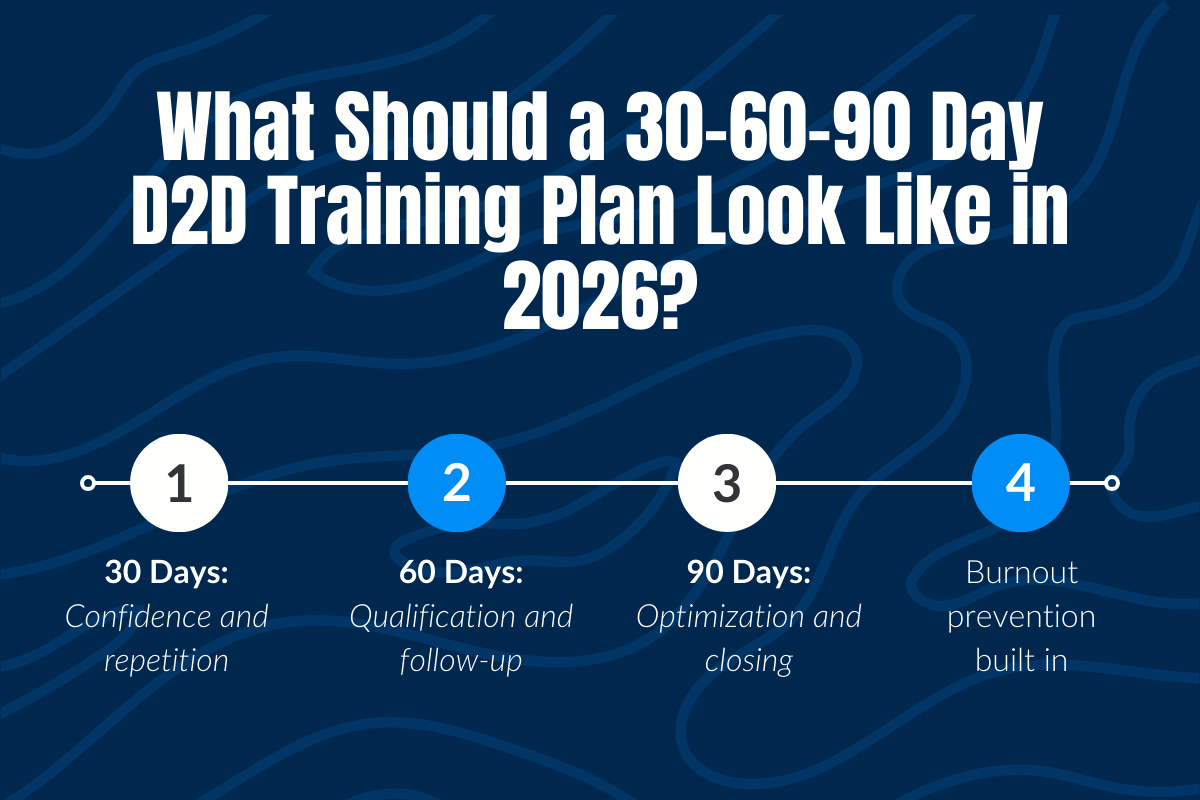
A structured 30-60-90 day plan helps new reps build skills gradually while avoiding early overload. Instead of pushing for immediate results, effective plans focus on confidence, consistency, and measurable progress.
First 30 Days: Territory Basics and Confidence Building
The first month centers on understanding territory fundamentals and building comfort in real conversations.
Reps learn how routes work, how to approach households, and how to start conversations without relying on a memorized sales pitch.
The goal is repetition and confidence, and early exposure to door-to-door sales conditions helps normalize rejection and reduce hesitation at the door.
Metrics to track: doors approached, conversations started, comfort level during interactions.
Days 31–60: Qualification and Follow-Up Discipline
In the second phase, training shifts toward identifying intent and managing follow-ups. Reps practice qualifying interest quickly, asking better questions, and maintaining consistent follow-up routines.
Real performance data is introduced so reps can see patterns in outcomes rather than guessing what works.
Metrics to track: qualified conversations, follow-ups scheduled, response rates.
Days 61–90: Optimization and Closing Frameworks
The final phase focuses on refinement. Reps develop an optimization mindset by adjusting routes, improving timing, and applying structured closing frameworks.
By this stage, reps understand how their daily decisions affect results and can operate more independently within the company or business model.
Metrics to track: conversion rates, appointments booked, and closed outcomes.
>> How to Prevent Early Burnout During Ramp-Up
Burnout prevention is built into the plan. Training volume increases gradually, feedback remains frequent, and expectations are aligned with learning stages.
Reps are coached to separate outcomes from self-worth so that, as new salesman, they can focus on improvement rather than short-term results.
How Do You Know If Your D2D Training Is Actually Working?
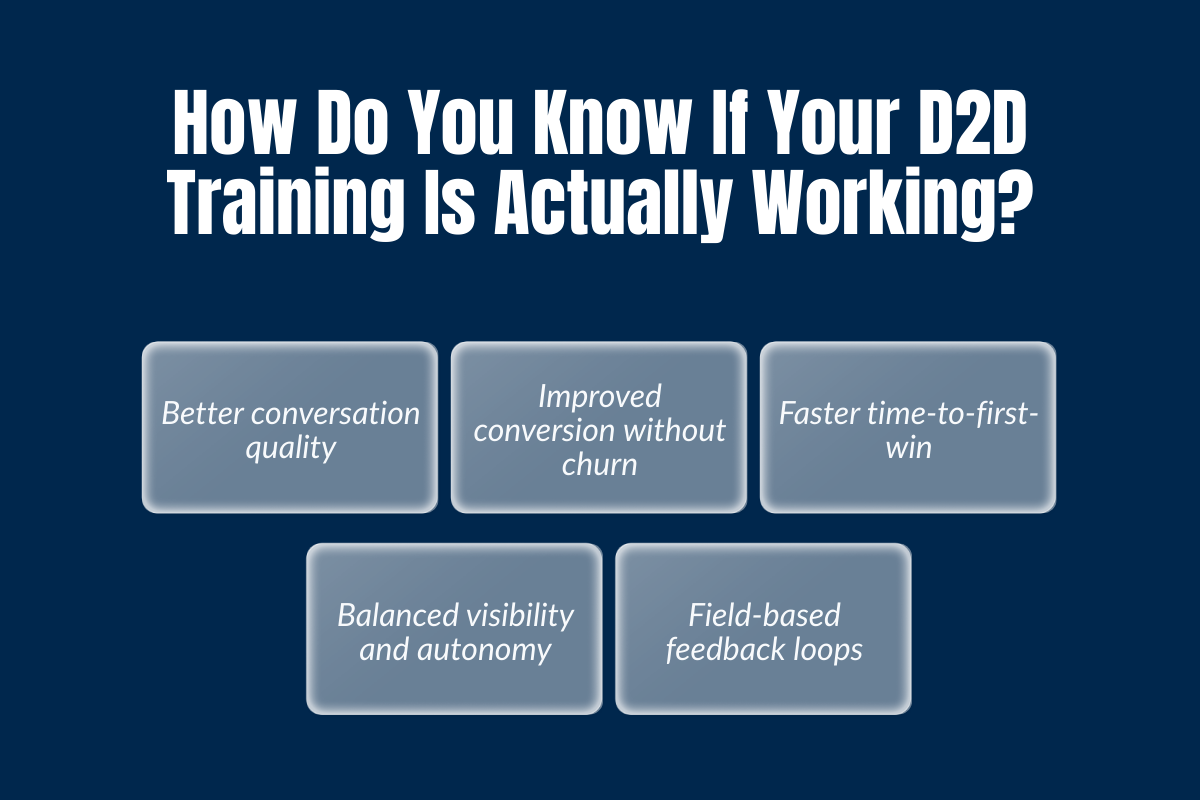
Measuring training effectiveness in door-to-door sales requires looking beyond surface-level activity. High-performing teams evaluate whether training improves behavior, outcomes, and retention.
1. Leading Indicators: Activity Quality Over Volume
Early signals come from how reps work, not how much they work, and strong training improves activity quality, leading to better conversations, clearer qualifications, and more consistent follow-ups.
When effort is high, but outcomes are inconsistent, reviewing door-to-door sales analytics metrics that matter can help your team identify whether training is influencing the right behaviors.
Simply increasing knock counts without improvement in interaction quality rarely translates into better sales performance.
2. Conversion Lift Compared to Rep Churn
Effective training shows up as a gradual improvement in conversion without a spike in attrition. If conversion rates rise while churn remains stable or decreases, it suggests reps are learning sustainably.
When conversion gains come alongside high turnover, training may be pushing results at the expense of long-term retention, making it harder to retain top talent.
3. Time-to-First-Win as a Training KPI
Time-to-first-win is one of the clearest indicators of training impact. When new reps reach their first meaningful outcome sooner, it signals that onboarding and coaching are aligned with real field conditions in door-to-door sales.
4. Balancing Manager Visibility With Rep Autonomy
Training works best when managers have visibility into activity without micromanaging execution.
Real-time insights allow managers to coach selectively while giving reps space to build judgment and leadership skills in the field. Too little visibility delays support and too much erodes confidence.
5. What to Audit in Your Training Process This Quarter
Teams evaluating their training should focus on a few core questions:
- Are reps getting feedback based on real field activity?
- Is follow-up behavior visible and coachable?
- Do managers have clarity on where reps struggle most?
- Are improvements tracked consistently over time?
Auditing these areas often reveals whether training is truly systemic or still dependent on individual effort.
How Knockbase Supports Modern D2D Training (Without Replacing Human Coaching)?

Modern door-to-door training works best when technology reinforces coaching rather than automating it. Field platforms like Knockbase support this shift by making real field behavior visible, measurable, and easier to coach against.
1. Turning Field Activity Into Coachable Insights
Field activity data provides a clearer picture of where training succeeds and where it breaks down. Territory-level insights help identify gaps such as inconsistent coverage, poor timing, or low follow-up rates that may not surface through manual reviews.
By spotting patterns in rep activity, managers can see where reps consistently struggle and where they perform well, allowing coaching to focus on specific skill gaps rather than assumptions.
2. Helping New Reps Build Structure From Day One
Early-stage reps often struggle not because of effort, but because of uncertainty. Clear routes, defined territories, and visible daily goals reduce guesswork and help new hires focus on execution instead of decision fatigue.
This structure lowers early overwhelm and allows reps to build confidence through repeatable routines rather than trial-and-error.
3. Reinforcing Follow-Up Discipline in the Field
Follow-up is easier to coach when it’s visible. By tracking outcomes and next steps, field tools make follow-up behavior measurable instead of abstract.
This allows managers to train reps to treat follow-up as a revenue-driving skill, one that improves with consistency and timing, rather than a task handled at the end of the day.
4. Enabling Managers to Coach With Data
Access to performance trends allows managers to personalize coaching based on actual field behavior. Instead of relying on anecdotal feedback, managers can adjust training based on patterns across routes, conversations, and outcomes.
Faster feedback loops help reps correct issues sooner, accelerating improvement without increasing pressure.
Conclusion: Train for the Field Your Reps Actually Work In
Door-to-door sales in 2026 are faster, more adaptive, and increasingly data-informed. Training models that rely on speeches and static materials struggle to keep pace with real-world conditions.
Teams that modernize training don’t just improve sales performance. They retain reps longer by reducing confusion, burnout, and inconsistent coaching.
The objective isn’t to train more often, but to enable reps to perform better in the environments they actually operate in. The future of door-to-door training belongs to systems that support learning in motion, reinforce good habits daily, and evolve alongside the field itself.
Ready to Build Better Field Coaching?
See how Knockbase supports consistent training and coaching by making field activity visible and actionable.
Book a quick 15-minute demo to explore it in action.
FAQs
1. What makes modern door-to-door sales training different in 2026?
Modern training focuses on systems, real field data, and continuous coaching instead of one-time onboarding or motivational sessions.
2. How can teams measure whether their training is improving sales performance?
Teams track leading indicators like conversation quality, follow-up discipline, time-to-first-win, and rep retention rather than volume alone.
3. Why do traditional scripts fail in door-to-door sales?
Scripts struggle in real conversations where interruptions, objections, and time pressure require adaptability rather than memorization.
4. How does better training help reps close deals more consistently?
By teaching qualification, follow-up timing, and conversation frameworks, reps make fewer assumptions and focus on higher-intent prospects.
5. Can this training approach work for industries like pest control?
Yes. Industries with short, in-person sales cycles benefit from structured coaching, territory insights, and consistent follow-up practices.
6. How does modern enablement address customer concerns more effectively?
Reps are trained to listen, adapt responses, and adjust conversations in real time instead of relying on fixed pitches.
7. Does better training actually lead to long-term success for reps?
Yes. Structured enablement reduces burnout, improves confidence, and helps reps earn more money over time without relying on constant pressure.