Door-to-door pest control sales have been one of the most reliable growth channels in the pest control industry for years. Many of the largest pest control companies built their early customer base by knocking on doors in targeted neighborhoods and offering immediate pest control services to homeowners.
However, scaling and building rapport are difficult tasks. When a pest control company has one or two sales representatives knocking on doors, performance is easy to manage. But once teams grow to 10, 20, or even 50 door-to-door salespeople, new problems start to appear.
Sales performance becomes inconsistent. Some door to door salesman close deals every day, while others struggle to generate conversations, and there are high chances of errors in high-pressure tactics in local companies.
For pest control owners and sales managers trying to scale operations, the goal is not just more door-knocking. The goal is to build a system that creates predictable results across seasons.
The Ultimate Guide to Excel Door-to-Door Pest Control Sales
Pest control demand naturally increases in warmer months, especially during spring and summer when insects and other pests become more active. This creates a pattern where companies see strong revenue in peak months but struggle to maintain momentum during fall and winter.
To address this gap, door-to-door pest control sales software helps teams operate more strategically by using real-time data, GPS tracking, and automated workflows to manage leads, optimize routes, and improve follow-ups.
In this blog, we will talk about the best sales pitch that closes sales faster and create awareness about how door-to-door pest control sales software helps you schedule follow-ups and other benefits of using it.
Key Takeaways
- Pest control demand is seasonal, but sales pipelines can still be predictable with the right systems.
- The biggest scaling problem is not the lead volume. It is an inconsistent rep performance.
- Tracking every door knocked helps managers understand field performance.
- Recurring service plans generate long-term revenue from door-to-door sales.
- Modern canvassing software helps teams turn daily activity into structured data.
The Real Challenge: Pest Control Sales Are Seasonal, But Your Revenue Shouldn’t Be
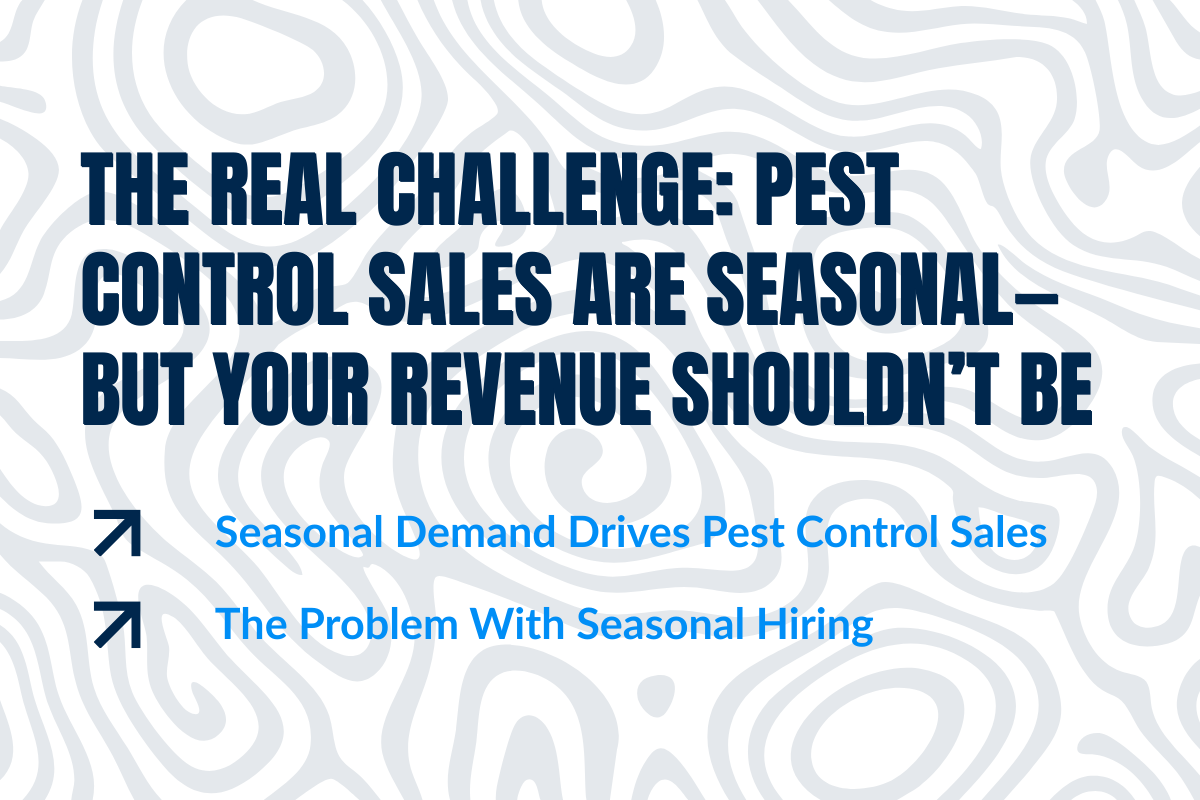
A. Seasonal Demand Drives Pest Control Sales
The pest control industry naturally experiences seasonal demand. As temperatures rise, pest problems such as ants, termites, spiders, and mosquitoes become more active.
This is when homeowners start noticing pest issues and look for treatment services. Because of this, most pest control companies see the highest demand during spring and summer.
B. The Problem With Seasonal Hiring
To capture this demand, many companies rapidly hire their door-to-door pest control salespeople during peak months. More sales reps means more neighborhood coverage and faster customer acquisition.
However, when fall arrives and pest activity slows down, sales opportunities decline. Reps struggle to maintain the same performance levels, and revenue becomes less predictable.
C. Common Problems Caused by Seasonality
Seasonal sales cycles often lead to several operational challenges:
- Over-hiring sales reps during peak months
- Lower productivity during fall and winter
- Reduced sales momentum after the summer
- Revenue instability across quarters
The Smarter Approach:
The most successful pest control companies do not try to eliminate seasonality. Instead, they build systems that support a year-round door-to-door sales pipeline.
By structuring their sales activities across seasons, they maintain a steady lead flow and avoid starting from zero each spring.
The Real Scaling Problem: Inconsistent Rep Output, Not Lead Volume
1. More Reps Do Not Always Mean More Sales
Many pest control owners believe that hiring more sales reps will automatically increase revenue. The logic seems simple. If ten reps generate a certain number of deals, then twenty reps should generate twice as many.
But in door-to-door pest control sales, it rarely works that way. Most teams have a big performance gap between top performers and average reps.
A few strong sales reps often generate the majority of revenue, while others struggle to maintain consistent results.
2. The Real Focus: Rep Productivity
Because of the above gap we discussed, the real challenge is not lead volume. It is improving the productivity of the entire sales team.
High-performing pest control companies track daily activity metrics instead of focusing only on final sales numbers. They build systems that improve the average rep’s output by standardizing processes like pitch delivery, follow-ups, route planning, and lead handling.
Instead of asking “How do we get more leads?”, they focus on:
- How consistently do reps convert conversations into leads
- How efficiently reps move leads to closed deals
- How quickly reps follow up and re-engage prospects
When you improve these inputs, overall sales performance becomes predictable and scalable.
3. Key Metrics Top Teams Track
Successful teams monitor:
- Doors knocked – Measures effort and coverage
- Conversations with homeowners – Indicates engagement quality
- Leads captured – Tracks conversion from interaction to opportunity
- Deals closed – Reflects sales effectiveness
- Follow-ups scheduled – Ensures pipeline continuity
Tracking these numbers helps managers quickly identify where reps need coaching and how to improve performance.
How High-Performing Pest Control Teams Choose Neighborhoods?
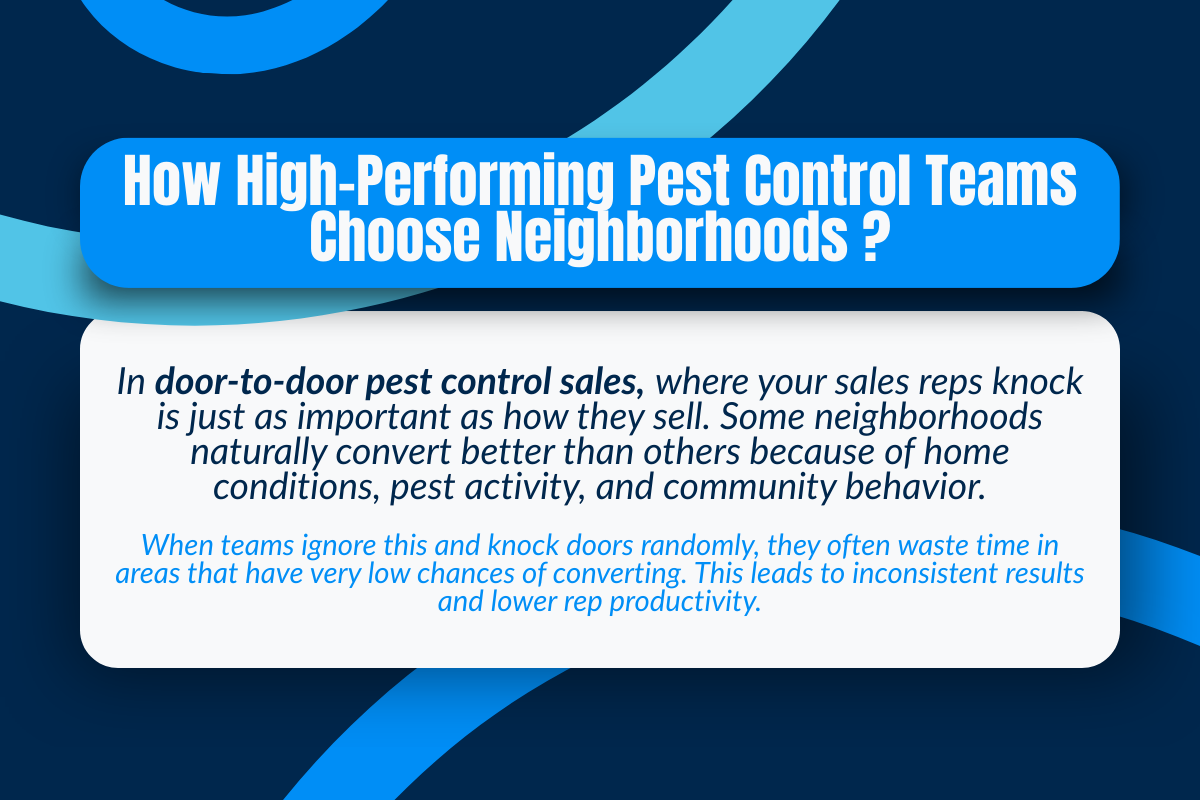
In-door-to-door pest control sales, where your sales reps knock, are just as important as how they sell. Some neighborhoods naturally convert better than others because of home conditions, pest activity, and community behavior.
When teams ignore this and knock on doors randomly, they often waste time in areas that have very low chances of converting. This leads to inconsistent results and lower rep productivity.
High-performing pest control companies avoid this by using data to choose the right neighborhoods before sending reps into the field.
1. Key Factors Teams Look At Before Canvassing
Successful teams evaluate several neighborhood characteristics to identify areas with higher potential for pest control services.
Some of the most common data points include:
- Age of homes in the neighborhood
- Lawn size and landscaping conditions
- Presence of homeowner associations (HOAs)
- Past pest infestation patterns
- Density of previous pest control treatments
Older homes, for example, often have more entry points for pests. Larger yards can attract insects and rodents due to vegetation and soil conditions. HOA communities can also respond well to pest control offers because neighbors often influence each other's decisions.
2. Scattered Knocking vs Cluster-Based Canvassing:
Another key difference between average teams and high-performing teams is how they cover neighborhoods.
- Scattered knocking happens when reps move randomly between streets or neighborhoods. This approach often results in missed houses, inefficient travel, and weaker social proof.
- Cluster-based canvassing focuses multiple reps in the same neighborhood at the same time. This creates visible activity, increases the chances that homeowners see neighbors signing up for service, and makes follow-ups easier.
Because of this momentum effect, clustered canvassing usually leads to stronger conversion rates and better overall sales results.
The 3-Phase Pest Control Canvassing Cycle That Reduces Seasonality
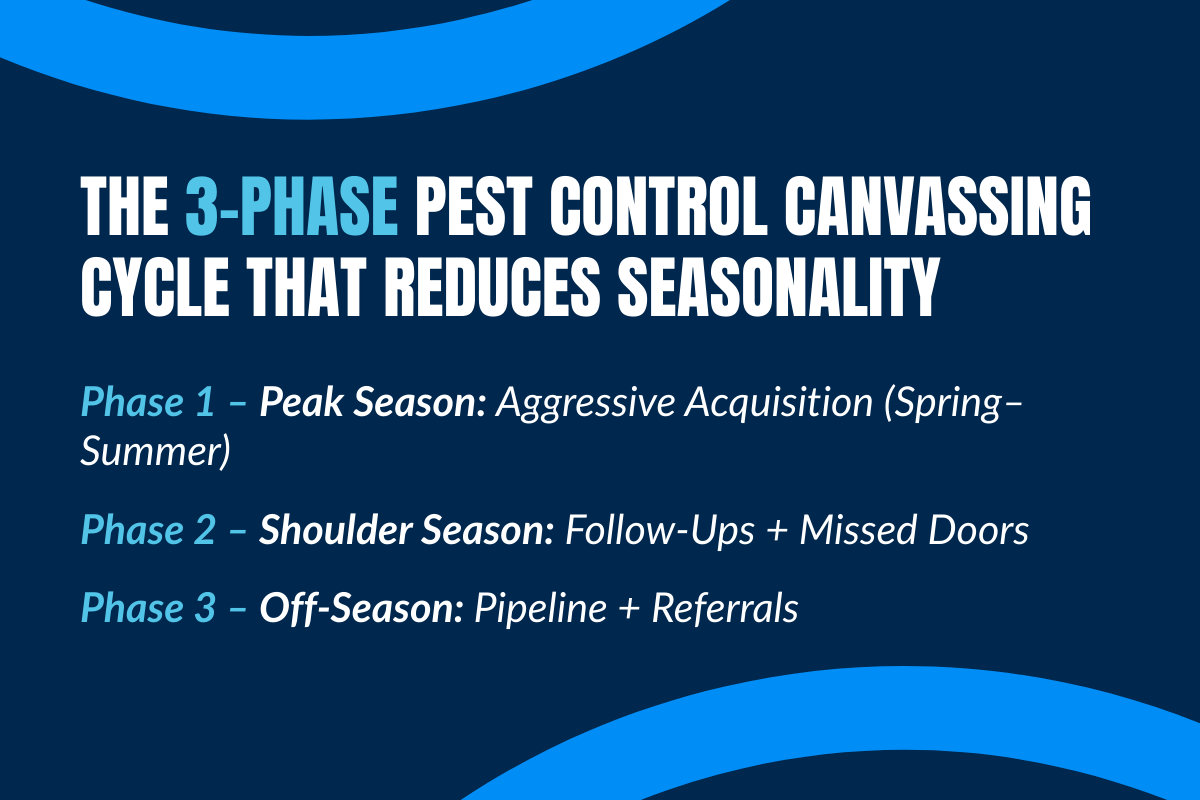
Phase 1 – Peak Season: Aggressive Acquisition (Spring–Summer)
Spring and summer represent the strongest demand period for pest control services. Insects become active, homeowners notice pest problems, and urgency increases.
During this phase, companies focus heavily on acquiring new customers. Sales teams deploy a higher number of representatives and cover neighborhoods quickly to capture opportunities while demand is high.
Peak season priorities
- Increase rep density in target neighborhoods
- Focus on rapid door coverage
- Emphasize new customer acquisition
- Track performance daily
Because demand is already strong during this period, efficient execution can generate significant revenue.
Phase 2 – Shoulder Season: Follow-Ups + Missed Doors
Many companies reduce their sales activity once summer ends. However, fall months provide an excellent opportunity to revisit potential customers who were missed earlier.
During peak season, many homeowners may not have been available when reps visited their homes. Others may have shown interest but asked to follow up later. The shoulder season is ideal for reconnecting with these prospects.
Shoulder season strategy
- Revisit neighborhoods that were canvassed earlier
- Follow up with warm leads
- Knock on doors that were not answered previously
- Saturate neighborhoods more thoroughly
These additional visits can convert a meaningful percentage of missed opportunities.
Phase 3 – Off-Season: Pipeline + Referrals
Winter is typically the slowest period for pest control sales. However, it is still valuable for building the pipeline for the following year.
Instead of focusing only on new customer acquisition, companies concentrate on strengthening relationships with existing customers. Satisfied homeowners often become powerful sources of referrals.
Off-season focus areas:
- Asking customers for neighborhood referrals
- Offering seasonal inspections
- Conducting light canvassing in high probability areas
Referral-based sales often produce significantly higher conversion rates than cold door knocking because trust is already established.
What Top Pest Control Sales Teams Do Differently in the Field?
Top pest control sales teams don’t rely on luck or just more leads to grow revenue. They build structured systems that improve how every rep performs in the field.
> They utilize a Pest Control Canvassing Software
1. They Track Every Door (Not Just Sales)
Many companies only measure final sales numbers. However, this approach hides important information about the sales process. Top teams track every interaction with homeowners.
Activity metrics are often recorded
- Total doors knocked – Measures effort and territory coverage
- Conversations started – Shows how effectively reps engage homeowners
- Leads captured – Tracks conversion from interaction to opportunity
- Follow-ups scheduled – Ensures no warm lead goes cold
- Deals closed – Reflects final sales performance
This level of tracking creates accountability and helps managers understand where improvements are needed.
2. They Shorten the Feedback Loop
Traditional teams review performance too late, when lost opportunities can no longer be recovered. On the other hand, top teams monitor performance daily, allowing them to fix issues while reps are still active in the field.
Managers can immediately see which neighborhoods are performing well, which reps need coaching, and where follow-ups should happen. This allows companies to adjust strategy while representatives are still active in the field.
3. They Standardize Winning Scripts (But Allow Flexibility)
Successful pest control sales teams refine their scripts based on real homeowner conversations. Over time, they identify messaging patterns that consistently generate interest.
A strong pitch typically includes:
- A quick explanation of neighborhood pest issues
- Social proof from nearby customers
- A simple explanation of the service plan
- A clear next step for scheduling treatment
However, the messaging often changes depending on the season. Spring conversations may focus on ants or termites, while fall messaging may highlight rodent prevention. The key insight is that preparation during slower months often determines success during peak season.
> The Hidden Revenue Lever: Recurring Plans from Door-to-Door Sales
One-time pest control treatments can generate quick income, but they do not create long-term business stability. Recurring service plans are what make pest control businesses scalable.
Instead of offering a single treatment, many companies present subscription-style pest control programs directly at the door.
Benefits of recurring pest control plans
- Predictable monthly revenue
- Higher customer lifetime value
- More efficient technician scheduling
- Stronger long-term customer relationships
What are the D2D Sales Software features that support a Pipeline-Driven Approach?
As pest control companies scale their door-to-door sales operations, managing field activity manually becomes difficult. Sales managers need visibility into where reps are working, how many doors are being knocked, and which leads require follow-up.
Modern pest control canvassing software helps organize territories, track rep activity, and maintain a consistent sales pipeline. The table below highlights the key features that support a more structured door-to-door sales process.
| Feature | How It Helps Sales Teams |
|---|---|
| Territory Mapping | Managers can divide cities into clear territories based on neighborhood characteristics and past performance |
| Route Optimization | Optimized routes reduce travel time between houses and help sales reps knock more doors each day, improving daily productivity. |
| Real-Time Rep Tracking | Sales managers can see where representatives are working in real time, making it easier to manage teams |
| Lead Capture and Follow-Up Sync | Every homeowner interaction can be recorded instantly, allowing reps to capture leads and schedule follow-ups |
| Performance Dashboards | Dashboards give managers quick insights into field performance, including doors knocked, conversion rates, and neighborhood results. |
How Modern Canvassing Software Like Knockbase Helps Pest Control Teams Track, Plan, and Scale?
As pest control companies grow their door-to-door sales operations, managing field activity manually becomes difficult. Modern canvassing platforms like Knockbase help bring structure and visibility to the entire sales process.
1. Turning Field Activity into Data
Knockbase converts everyday sales activity into organized data. Teams can track doors knocked, leads captured, follow-ups scheduled, and deals closed in one centralized system.
2. Maintaining a Year-Round Pipeline
Instead of starting from zero each season, teams can revisit neighborhoods with past interaction data. This helps reps follow up on missed doors and warm leads more effectively.
3. Aligning Territories and Reps
The platform helps organize territories and assign reps clearly, reducing overlap and ensuring better neighborhood coverage.
4. Real-Time Visibility for Managers
Managers can monitor field activity in real time and adjust strategies while reps are still working. The real advantage is consistency. When every door, lead, and follow-up is tracked, pest control teams can plan better and scale their sales operations more predictably.
Quick Implementation Plan (For Teams Starting This Quarter)
Scaling door-to-door pest control sales does not require massive operational changes immediately. Many teams start with a simple structured plan.
Week 1: Identify top-performing neighborhoods
Start by analyzing past sales data to find areas with the highest conversion rates. Focus on patterns like neighborhood type, pest issues, and response rates to prioritize where reps should spend time.
Week 2: Standardize sales scripts and activity metrics
Define a clear structure for sales conversations to ensure consistent messaging across all reps.
At the same time, start tracking daily activity metrics like doors knocked, conversations, leads, and follow-ups.
Week 3: Introduce territory planning and routing
Divide your service areas into clearly defined territories to avoid overlap and inefficiencies.
Plan daily routes for each rep to maximize coverage, reduce travel time, and increase productive selling hours.
Week 4: Analyze performance data and optimize strategy
Review key metrics such as conversion rates, rep performance, and neighborhood outcomes. Use this data to refine scripts, reassign territories, and coach reps based on real performance gaps. Even small structural improvements can produce noticeable gains in sales performance.
Final Take: Opt for door-to-door sales software
Many pest control companies believe scaling door-to-door sales simply means knocking more doors. In reality, growth comes from managing what happens after each knock.
The most successful teams track every interaction with homeowners, organize their canvassing efforts across seasons, and maintain consistent follow-up pipelines so opportunities are not lost.
This shift turns door-to-door sales from a simple activity-based approach into a system-driven growth model. Instead of relying on seasonal spikes, pest control companies that focus on data, visibility, and structured processes are able to build sales operations that grow more predictably throughout the year.
Scale More Deals with Building Rapport Through Pest Software
When every door, conversation, and follow-up is tracked, it becomes much easier to improve rep performance and manage territories effectively.
Modern canvassing platform Knockbase helps sales teams stay organized, optimize neighborhood coverage, and turn more homeowner conversations into long-term customers.
With the right systems in place, your team can move from unpredictable results to a more consistent and scalable sales pipeline. Book a demo right away!
FAQs
1. Is door-to-door pest control sales legit?
Yes, it is reasonable. Door-to-door pest control sales are an industry-wide recognized customer acquisition method.
2. Can you make good money in D2D sales?
Many different companies still use the door-to-door sales method, including pest control, solar, and home security companies, as well as roofing companies.
3. Does anyone do door-to-door sales anymore?
Yes, door-to-door sales are still widely used in industries like pest control, solar, home security, and roofing. Many companies prefer it because it allows them to target specific neighborhoods directly.
4. How much do top pest control sales reps make?
Top pest control reps may earn between $80,000 and $ 200,000+ per year, depending on performance and commission. Some of the top performers may receive large bonuses for selling recurring service plans at peak season.