Scaling door-to-door knocking activity does not automatically lead to business growth or stronger sales results. Simply adding more people to knock on more doors rarely solves operational challenges.
When you move from five to fifty people, instead of a productive hustle, it can turn into disorderly execution because structure and systems are missing.
This creates an operational breakdown where performance drops, stress increases, and results suffer even though the team is working harder than before.
High-performing door-to-door sales teams solve this problem by introducing structured processes and automation tools. These systems bring structure, standardize execution, and upskill canvassing teams to output measurable results while scaling.
How Do Door-to-Door Canvassers Scale Successfully as Teams Grow?
Door-to-door canvassing teams scale successfully by implementing standardized, repeatable training, using specialized CRM/mapping software for territory management, and fostering a high-energy, performance-driven culture.
When you plan to grow your team of D2D canvassers, it is not just about effective leadership and experience. It requires the right tools and strategies to knock on the high-intent doors to maximize positive results.
This blog will walk you through the actionable steps and correct use of automation tools to successfully scale door-to-door canvassing teams, boosting sales output or increasing voter turnout with simplified workflows that streamline execution.
Key Takeaways:
- Scaling fails when small inefficiencies and a lack of real-time visibility turn growth chaotic and challenging.
- Digital tools and structured workflows provide better visibility, real-time lead tracking, and automated follow-ups, saving hours of work and boosting conversions to help your team grow smoothly.
- The Knockbase canvassing app transforms effort into results, offering dashboards that track doors knocked, leads, win rates, and other metrics that empower smarter strategies and better outcomes.
Scale Field Teams with the Right Tools
Canvassing can drive rapid growth, but only top-performing canvassing tools truly empower field teams to double their win rates.
Book a Quick Demo to see how Knockbase supports your team in the field and scales effortlessly with your business.
What Stage Is Your Door-to-Door Team Really In?
You can't really know where you're going until you know where you have been,": Maya Angelou
These words truly stand fit here, because until you really know which growth stage you belong to, scaling is complex and vague without a defined goal.
Below are the four common stages most door-to-door sales teams go through as they expand:
1. The “Startup” Stage (1–5 reps)
In the early days, the team is small and flexible. Everyone is involved in multiple parts of the process—knocking doors, taking notes, managing leads, and following up with prospects.
Because the group is small, coordination usually happens informally. Leads may be tracked in spreadsheets, notebooks, or messaging apps. At this stage, the system feels simple enough to manage without much structure.
2. The “Growth Spurt” Stage (6–20 reps)
Once your team begins to grow, the pace changes quickly. More reps are covering more neighborhoods, and the number of daily conversations increases significantly.
Managers start spending more time planning territories, onboarding new team members, and trying to keep messaging consistent across the group. This is also when the first operational problems usually appear.
3. The “Regional Team” stage (20–75 reps)
At this stage, performance tracking, routing, and lead management become much more important. Without clear visibility into rep activity, it becomes difficult to maintain consistency and accountability across the team.
This is also where digital systems begin delivering measurable operational benefits. Teams can clearly see the ROI of a door-to-door knocking app for growing teams through better territory coverage, improved follow-up rates, and stronger pipeline visibility.
4. The “Multi-Market Operation” stage (75+ reps)
Large door-to-door organizations often operate across multiple cities or regions. Teams may include several managers, field supervisors, and dozens of canvassers working simultaneously.
At this scale, manual coordination is no longer sustainable. Successful organizations rely on systems that automate scheduling, track field activity, and provide real-time visibility into team performance.
Without these systems, even experienced teams can struggle with poor coordination, missed opportunities, and rep burnout. Digital platforms help maintain structure and efficiency as operations grow across multiple markets.
Why Do Scaling Problems Show Up Suddenly (and Not Gradually)?
1. Operational Visibility Breaks Down as Teams Scale
Small teams can coordinate informally through spreadsheets, calls, or messaging apps. But as the number of reps and neighborhoods increases, these systems stop providing reliable visibility into field activity.
They fail to prioritize customers, canvassing routes get complex, labour works longer hours, adding to overtime costs to handle the additional load, and many potential opportunities are lost in this chaos.
Managers also lose track of territory coverage, follow-ups become inconsistent, and performance signals get buried under scattered updates. Without a centralized system, it becomes difficult to identify problems early or guide reps effectively.
2. Territory Chaos Compounds Silently
As the number of homes and neighborhoods increases, managing territories becomes far more complex. Without clearly defined routes or proper planning tools, teams often end up covering the same streets twice while other areas remain untouched.
Reps spend more time driving between locations instead of having productive conversations at the door. Over time, these inefficiencies reduce daily productivity and make it harder for teams to meet their outreach goals.
3. Manual Tracking Breaks Under Real-World Pace
Managing 3–5 people works fine on spreadsheets and phone tracking. But as your team grows, the lack of real-time visibility and inefficient routing can cause a total breakdown.
Manual processes are slow, error-prone, and offer no way to optimize efforts or routes, with limited communication, which can lead to missing key areas and overlapping efforts.
This is where scaling door-to-door sales operations with automation and mobile tools becomes essential. Digital systems help teams capture leads instantly, organize territories more efficiently, and maintain consistent follow-ups as activity increases.
4. Small Inefficiencies Become Massive Revenue Leaks
Small cracks, when ignored, grow over time and eventually bring down the entire wall. Similarly, errors caused by small inefficiencies in manual door-to-door canvassing management slowly accumulate, eroding profits and performance.
Strong communication systems and digital tools help teams stay aligned in the field, making it easier to maintain consistency as operations grow.
What Changes As You Move From a Small Team to a Real Operation?
Scaling operations is not about simply adding more canvassing volunteers or hiring more sales reps to knock on more doors. It is about building a structured system with clear visibility, one that turns every effort into consistent results.
1. From Informal Routes to Structured Territory Planning
Small teams usually rely on a few members coordinating over phone calls and reaching as many doors as possible in each region, based on guesswork.
Scaling increases volume, and to maximize efforts across every region, structured territory planning becomes essential.
It balances workloads for every rep and uses data-driven insights to prioritize high-potential doors rather than as many doors as possible to deliver the best returns from every field day.
2. From Daily Check-ins To Real-Time Visibility
Smaller teams often rely on managers calling every few hours to check on reps’ job progress and undecided voters’ reactions.
As teams grow, this approach quickly turns into chaos. Digital canvassing tools solve this by providing real-time visibility into every field activity and task progress.
Mobile-first systems allow reps to update their progress directly from the field, while managers can see task updates and lead activity without interrupting the team. This keeps everyone aligned while allowing reps to stay focused on conversations rather than constant reporting.
3. From Instinct-Based Performance to Data-Driven Coaching
Performance feedback often comes from quick conversations or general observations. When you add more members to the team, your conversations or one-time instructions stop showing effectiveness.
More reps mean more variability in performance, and identifying patterns becomes harder without structured data.
Larger operations depend on performance insights to guide coaching. Managers can track metrics such as conversations logged, follow-ups completed, and conversion rates across different territories.
With clearer insights, coaching becomes more targeted, helping reps improve faster while maintaining consistent standards across the team.
4. From Reactive Problem-Solving to Proactive Planning
Canvassers may face obstacles in canvassing at various times due to multiple reasons.
For example, privacy concerns from residents, sudden weather or traffic disruptions, or trespassing issues in restricted neighbourhoods, these moments demand structured responses, not chaos that derails entire schedules.
However, as teams grow and schedules become tighter, reacting to problems at the last minute can quickly disrupt the entire workflow.
Digital tools enable a shift from reactive to proactive execution, offering real-time direction and instant triggers to adapt actions, so that teams work smarter and capitalize on every opportunity and obstacle.
How Can You Build Structure Without Killing Rep Autonomy?
1. Clear Expectations for Routes, Follow-Ups, and Outcomes
When canvassers are busy scrolling through old notes or juggling Google Maps during route disruptions, it drains their mental bandwidth.
Canvassing tools remove that friction by setting clear routes, providing instant access to customers, sending real-time alerts for schedule or route changes, and defining clear performance metrics. With less guesswork and more focus, reps convert better and deliver stronger results.
2. Lightweight Workflows Reps Can Actually Follow
Field teams adopt tools more easily when the system is simple and intuitive. A lightweight mobile app with a clear workflow helps reps quickly log conversations, track leads, and schedule follow-ups without slowing down their day.
When tools are easy to use, onboarding new reps also becomes faster. Teams can expand operations without spending excessive time training people on complicated systems.
3. Guardrails that Reduce Chaos Without Micromanagement
Strong leadership does not require controlling every move a rep makes. Overly rigid systems can limit creativity and make reps feel restricted in how they approach conversations.
The best teams perform when they have clear performance indicators, defined schedules and routes, and a live communication platform to connect at critical points.
This drives better results, and digital apps add an extra boost with built-in gamification like points, leaderboards, and rewards to engage and motivate the team.
See how Knockbase’s gamified door-knocking platform motivates reps, tracks progress, and helps teams consistently hit their field performance targets.
4. Feedback Loops that Improve Performance in Real Time
Digital tools provide AI-powered analytics in real time, helping identify trends, measure poll success, and refine strategies to keep teams on track.
Continuous feedback improves canvassing effectiveness, allowing resources and efforts to be allocated optimally.
5. Rules that Prevent Internal Competition
As teams grow, clear territory boundaries become essential. Without them, reps may unknowingly work the same neighborhoods or approach the same prospects multiple times.
A digital canvassing platform assigns specific areas to each rep and tracks territory coverage across the team. This keeps outreach organized, prevents duplication, and ensures every area receives consistent attention.
Which Canvassing Metrics Actually Matter When You Scale?
The phrase stands fit, as scaling without data is like walking blindfolded; you are not moving forward, just circling the same area and stumbling over obstacles you could have avoided.
Here are the essential metrics that matter in canvassing efforts to gauge your real output:
1. Doors Knocked vs. Conversations Started
The number of doors knocked each canvass day must be recorded to reveal consistency in field-based efforts.
Many knocked on doors close without conversations, so a record of interactions with the number of doors closed reveals actual doors where pitches were delivered.
2. Conversion Rates by Territory, not Just by Rep
The data must reveal the percentage of prospects who converted into satisfied customers in each region, with separate analytics to uncover the performance of every rep.
This helps understand the effectiveness of door-to-door sales pitches and territorial performance, showcasing which areas drive positive sales outcomes or secure the majority of votes in an election.
3. Follow-Up Speed as a Hidden Growth Lever
When you build rapport and connection with a follow-up when the conversations are still fresh, you are likely to convert more.
It is important to measure the time between a prospect’s initial inquiry and the first response or follow-up, as this has a direct impact on conversion rates.
4. Team-Wide Activity Trends vs. Individual Outliers
Team-wide activity trends are important to understand the overall performance of canvassing efforts, while individual rep performance identifies gaps that can be trained and moulded for better output.
5. Spot Burnout Signals in Performance Data
It is important to understand completed sales, or the success rate, to expose operational gaps and meet accurate sales targets.
6. Using Metrics for Coaching, not Punishment
Field data, such as rep activity, conversion rates, and follow-up success, provides valuable insight into how teams perform.
When managers use these metrics for guidance and support rather than criticism, it creates a culture focused on improvement and stronger results.
Five Reasons Scaling Teams Fail (Common Mistakes Growing Teams Must Avoid)
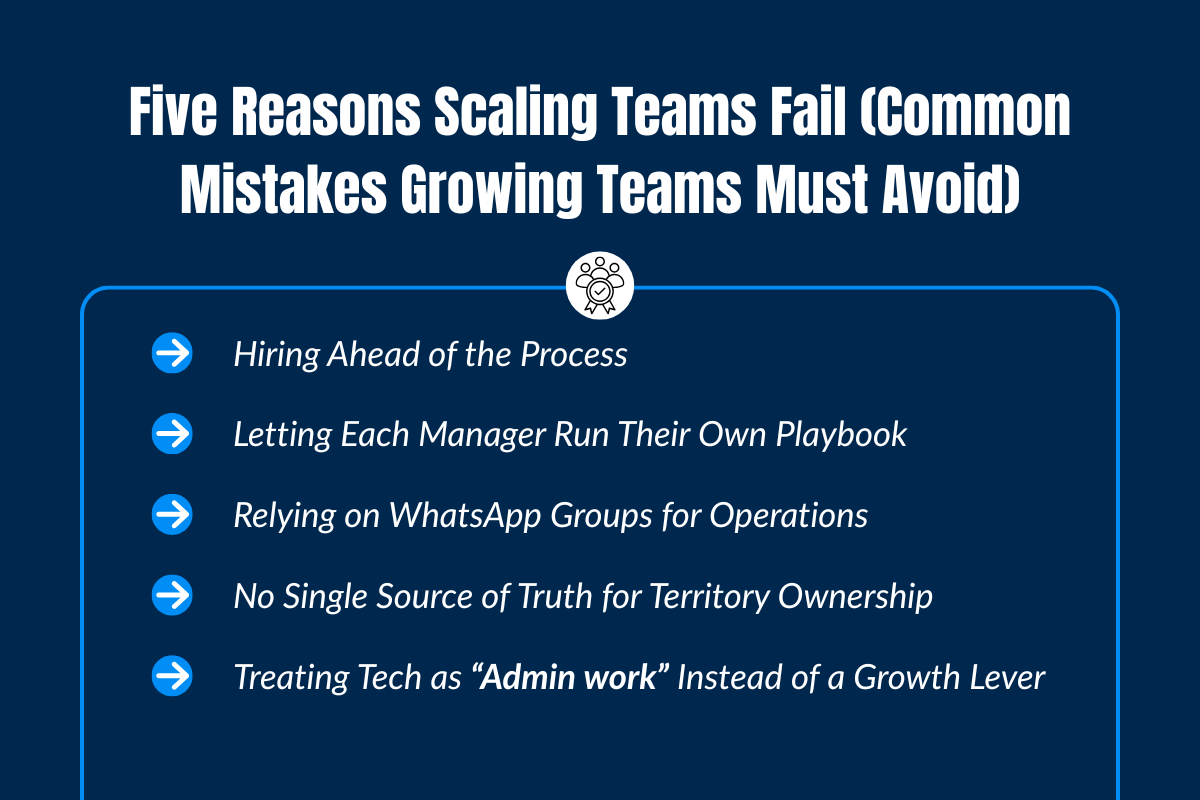
Many operational failures are predictable, but they can be prevented if you take the right action before small cracks turn into a complete breakdown.
Let us uncover the five main reasons that can fail your growing team:
1. Hiring Ahead of the Process
When demand increases, the first instinct is to hire more people. But adding headcount without improving the underlying system usually makes operations more complicated instead of more productive.
Larger teams require clear territory planning, structured training, and coordinated scheduling. Without those foundations in place, new hires add pressure on managers, increase payroll costs, and create more operational confusion rather than better results.
2. Letting Each Manager Run Their Own Playbook
As teams grow, different managers sometimes begin running their own version of the process. While this may seem flexible at first, it quickly leads to inconsistent training and mixed expectations across the organization.
New hires end up learning different methods depending on who trains them, which makes performance harder to standardize. Over time, the lack of a shared playbook leads to coordination issues and inconsistent results.
3. Relying on WhatsApp Groups for Operations
Endless check-ins on calls or WhatsApp get ignored when reps are on the move, and updates get delayed, too.
Once the team grows, group chats are cluttered with endless messages, making it difficult to retrieve essential data at critical hours.
Moreover, keeping track of information across dozens of fast-moving groups becomes pure chaos.
4. No Single Source of Truth for Territory Ownership
Without centralized access to critical information and real-time syncing, reps can end up visiting the same neighbours, which can be frustrating to homeowners and lead to wastage of time and effort, missing other critical regions.
Overlapping reps within the same region also sparks unhealthy competition and disputes among team members.
5. Treating Tech as “Admin work” Instead of a Growth Lever
Some teams view digital tools as administrative overhead rather than strategic infrastructure. In reality, the right systems help teams understand what is working and where improvements are needed.
Modern platforms provide insights into performance patterns and conversation outcomes. When used correctly, these tools help leaders make smarter decisions that improve efficiency and drive stronger results.
How can Knockbase Canvassing Software become the Operating System to scale in Effective ways?
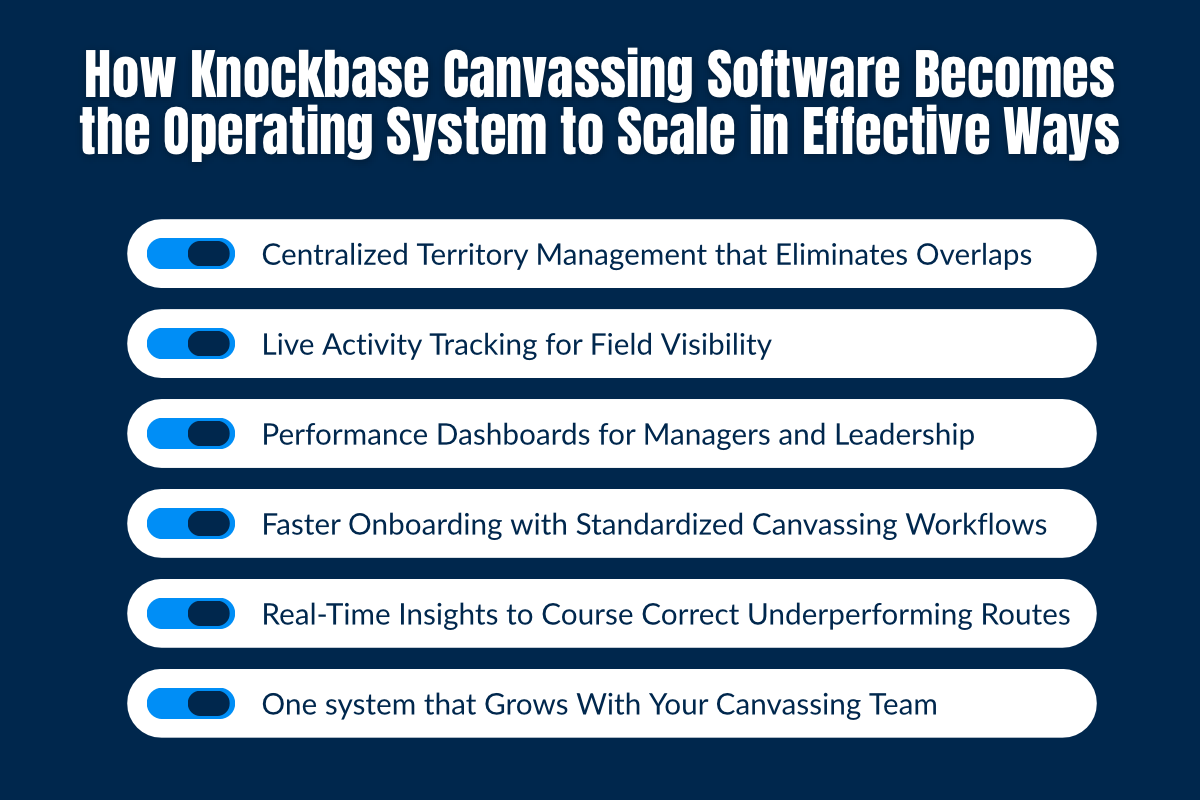
Knockbase is built to help growing door-to-door teams move beyond spreadsheets, scattered notes, and endless chat groups.
By combining territory planning, live activity tracking, performance insights, and mobile-first workflows, Knockbase helps teams coordinate field work more efficiently as they scale.
Managers gain clearer oversight of operations, while reps receive structured routes and easy tools to capture conversations and follow-ups directly from the field.
Let us explore what the Modern Scalable Canvassing with Knockbase brings to us:
1. Centralized Territory Management that Eliminates Overlaps
Knockbase provides a clear overview of assigned territories and rep activity across the team. Managers can allocate specific areas to each rep based on location and coverage priorities.
This prevents overlapping routes, ensures neighborhoods are covered efficiently, and helps teams focus on high-potential areas instead of duplicating effort.
2. Live Activity Tracking for Field Visibility
With GPS-enabled tracking and live activity updates, managers can see where reps are working and how outreach is progressing throughout the day.
Field teams can log visits, update lead status, and receive route adjustments without constant phone calls or manual check-ins, keeping everyone aligned while reps stay focused on conversations.
3. Performance Dashboards for Managers and Leadership
Knockbase includes built-in analytics dashboards that help teams track key performance indicators such as doors knocked, appointments booked, and conversion trends.
These insights help managers identify patterns, evaluate territory performance, and make smarter decisions to improve overall outreach effectiveness.
4. Faster Onboarding with Standardized Canvassing Workflows
Scaling teams often struggle with onboarding new reps quickly. Knockbase simplifies this process with structured workflows and a mobile-first interface that new team members can learn quickly.
Because the system is intuitive, reps can begin logging leads and following routes within hours instead of spending days learning complicated tools.
5. Real-Time Insights to Course Correct Underperforming Routes
Field conditions can change quickly due to weather, traffic, or unexpected disruptions. Knockbase allows managers to adjust routes and priorities in response to these changes.
By monitoring territory activity and rep progress, teams can shift their focus toward underperforming areas or opportunities that require additional attention.
6. One system that Grows With Your Canvassing Team
The system can accommodate expanding teams, scaling from small groups to larger organizations, by automating workflows without needing additional feature add-ons to support your growing team. Data flows smoothly, even as team size and locations increase.
What Does a Scalable Canvassing Operation Look Like in Practice?
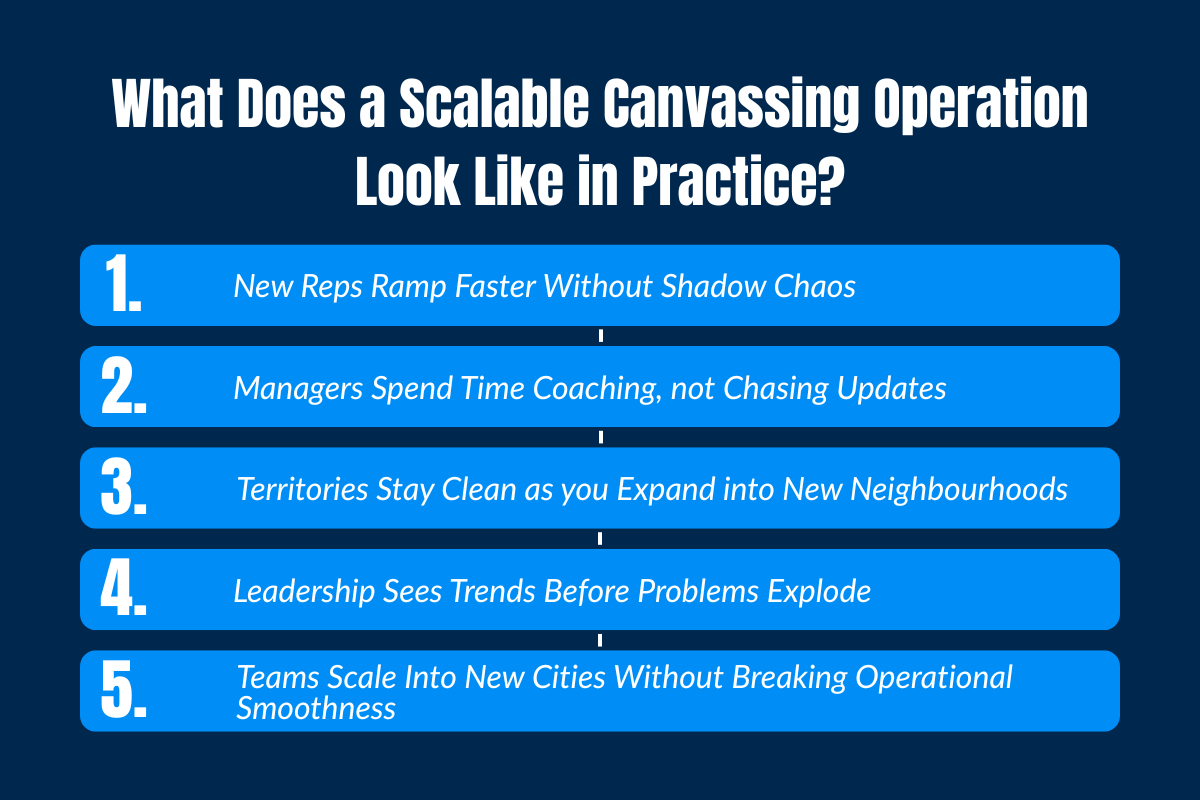
1. New Reps Ramp Faster Without Shadow Chaos
A modern ramping process uses digital tools to ensure reps spend more time meeting potential residents, while every step is documented and measured. It uses built-in training methods and key metrics defined to provide a clear path to every rep.
Real-time communication brings proactive education to new reps at all times, so that scaling feels structured and controlled without chaos.
2. Managers Spend Time Coaching, not Chasing Updates
In small teams, managers often spend most of their time checking in with reps to understand what is happening in the field.
As operations scale, modern canvassing systems replace manual check-ins with automated data capture and activity tracking. This gives managers instant visibility into performance, allowing them to focus on coaching reps, refining outreach strategies, and improving conversion outcomes.
3. Territories Stay Clean as you Expand into New Neighbourhoods
Moving to tech-enabled scaling allows for organized expansion with zero overlap and clear visibility. It ensures political campaign or sales messages reach the maximum number of doors in the minimum time by using GPS-powered geofencing for allocation of reps, tracking, and real-time location monitoring of all sales reps.
This eliminates territory overlap, prevents double knocking, and keeps field operations precise and efficient.
4. Leadership Sees Trends Before Problems Explode
As teams grow larger, small issues can quickly turn into major operational problems if they are not spotted early. Analytics dashboards help leadership track patterns across territories, reps, and outreach activity.
By identifying trends early, managers can adjust strategies, improve training, and address underperforming areas before performance drops
5. Teams Scale Into New Cities Without Breaking Operational Smoothness
Digital tools provide real-time communication, allowing field reps to upload photos, videos, and key talking points from resident interactions, all with live location visibility and automated follow-ups on important tasks.
By automating workflow communication, teams can multiply their reach geographically with efficiency while keeping people and processes in sync.
Final Take: Scaling Door-to-Door Isn’t About Hustle But About Systems
Growing a door-to-door canvassing team takes massive effort, but without a structured system, that hustle will never help you scale. Scalability is not synonymous with adding more people for canvassing to run local campaigns.
It is about building a system that empowers teams to operate efficiently, stay aligned, and consistently deliver the results you desire.
Digital software can assist you in building revenue by automating repetitive tasks, handling follow-ups, and providing real-time visibility to managers for strategic actions.
Book a Quick Demo with our experts today and get a personalized walkthrough to see how Knockbase helps you scale your team and results, without the complexity or affordability concerns.
Frequently Asked Questions:
1. When Should a Door-to-Door Team Start Investing in Automated D2D Tools?
Door-to-door teams must switch to automated tools when dependency on manual processes like basic spreadsheets or note-taking creates bottlenecks that lead to missed follow-ups, lower territory coverage, high sales rep turnover due to burnout, and inconsistency in performance.
2. What are the Biggest Signs that a Canvassing Team isn’t Scaling Properly?
The red flags that form the biggest concerns to canvassing teams hindering scaling efforts are:
- Higher D2D reps turnover rate due to burnout among both experienced staff and new hires.
- No real-time visibility into doors knocked, jobs completed, or voter interactions to understand their needs and concerns, making it difficult to determine bottlenecks in operations.
- Inconsistent performance marked by low conversion rates and rising labour costs.
- Poor resource utilization results in limited territory coverage and wasted productive hours.
- Increasing customer acquisition costs without a proportional rise in revenues.
3. Which Metrics Matter Most when Managing Large Canvassing Teams?
The key performance indicators that need to be tracked for efficiency in door-to-door canvassing activities include territory coverage area, turnover rate, conversion rate, contact rate, lead qualification numbers, canvasser-to-voter engagement ratio, and average deal size.
4. Why do Most Growing Canvassing Teams Fail Despite Hiring Good Reps?
The best reps fail to engage more supporters for political campaigns, or sales reps are unable to close deals despite training and experience, due to a lack of structured digital tools to streamline workflows and generate data-driven insights needed to derive useful information to implement better strategies for desired results.